


Makigama | Seto Blue and White Glazed Sake Carafe with Cherry Blossoms
Makigama | Seto Blue and White Glazed Sake Carafe with Cherry Blossoms
Shipping: ¥700 flat rate / half-price shipping on orders of ¥11,000 or more
Couldn't load pickup availability
FAQ
Is it microwave and dishwasher safe?
Most pieces can be used in the microwave and dishwasher. Please avoid both for pieces with gold or silver decoration, earthenware with crackle glaze, and figurines. Hand washing is recommended for long use.
Will it look exactly like the photo?
Each piece is fired one by one at the kiln, so color, glaze flow and size vary slightly. Please enjoy it as the character of handmade ware.
When will it ship?
Orders ship within 3–5 business days via Yamato Transport. We will email you when it ships.
How much is shipping?
Shipping is ¥700. Orders of ¥11,000 or more get half-price shipping.
What if it arrives broken?
Please email us (masukichi@hitotsuchi.jp) within 7 days of arrival. We will replace or refund it at our cost.
Can I see it in person?
Many pieces are on display at our shop, Masukichi, in Seto, Aichi.


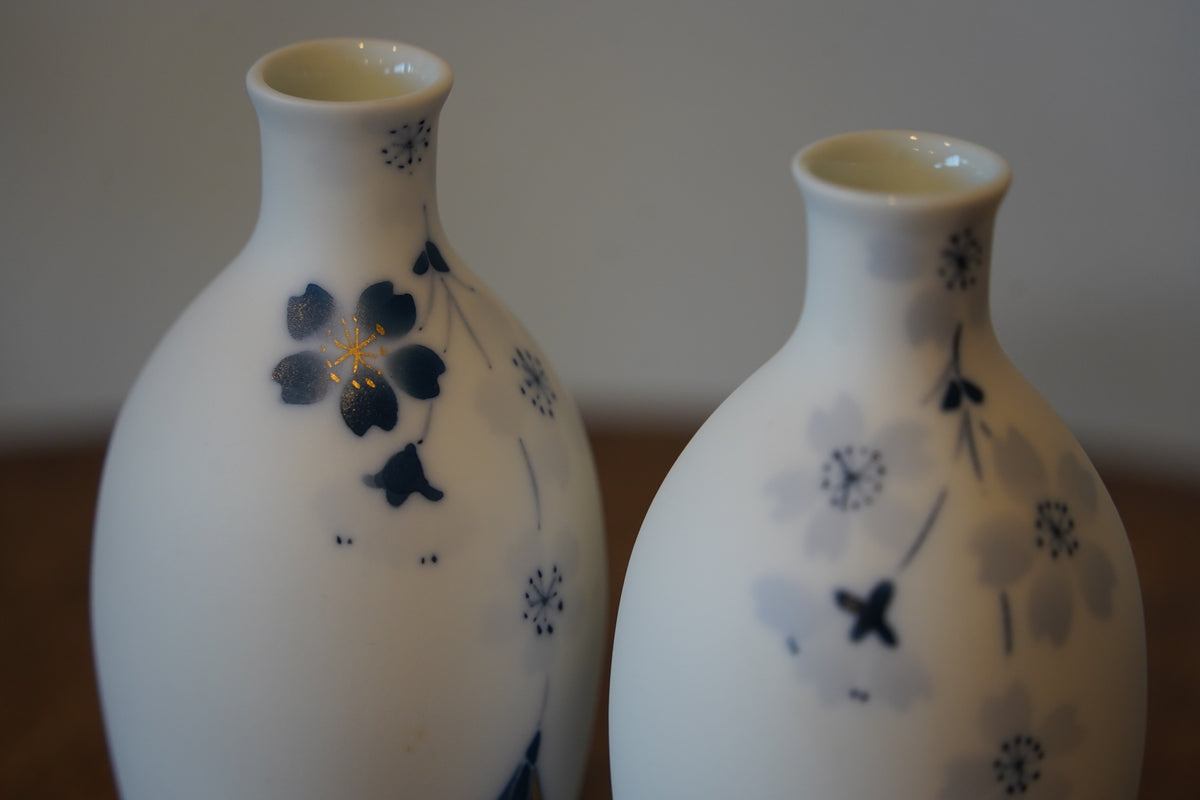
This sake vessel is made by Shin-gama, a sometsuke pottery studio in Seto City, Aichi Prefecture, founded in 1919. It is a beautiful tokuri from the Sakura series, featuring cherry blossoms carefully painted one by one on a calm, matte-textured base.
Shin-gama is a pottery studio that produces Seto sometsuke ware, which is designated as a traditional craft. Its distinctive style features vibrant blue designs painted on a pure white base.

A tokuri and an ochoko.

Two different designs. It is a surprise as to which one you will receive.
The combination of deep blue on a white background with subtle touches of gold creates a luxurious impression that is both elegant and sophisticated.

 Front and back. The back is pure white.
[About the Product]
Product Name: Seto Sometsuke Sakura Tokuri (One of two different designs, delivered at random)
Material: Porcelain
Size: Height 14.5 cm, Bottom Diameter 4.5 cm × Middle Diameter 6.5 cm × Spout Diameter 2.5 cm
Texture: Matte
Microwave: Not suitable Dishwasher: Not suitable
Manufacturer: Shin-gama
[Important Notes on Returns and Exchanges]
For returns or exchanges due to customer convenience, the customer is responsible for the round-trip shipping costs. Even if the item is unused, returns or exchanges due to differences in size, design, or color from what was expected will be considered a return due to customer convenience. Please note that the color, texture, and other characteristics of the product may differ slightly from the actual item depending on your browser, monitor performance, and settings.
[Introducing the Maker of Seto]
Shin-gama, a pottery studio founded in 1919 that produces Seto sometsuke ware, a traditional craft

Shin-gama is located in the nature-surrounded area of Takano in Seto City. The studio is nestled in the mountains, where you can hear the chirping of birds.
At Shin-gama, the third generation, Shinya Kato and Mihoko Kato, work together with several artisans, led by the fourth generation, Mayuki Kato, the youngest traditional craft artisan in Seto sometsuke ware.

Mayuki Kato, the youngest traditional craft artisan in Seto sometsuke ware.
Sometsuke is pottery with an underglaze design painted on a porcelain base using a pigment containing cobalt oxide. At Shin-gama, the designs are painted using brushes of various thicknesses, most notably a brush with a very large tip called a “dami brush.”


The pigment settles perfectly within the pencil outlines and is absorbed into the base. The variations in shade depend on the speed of the brush strokes, and it is captivating to watch.
The pure white base is also made in the studio

At Shin-gama, white porcelain clay is purchased from Maruseki Ceramic Raw Materials, a raw materials company in Seto City, and the clay is formed using molds.

First, the clay is turned into a mud-like substance called “nindo.”


Once it has become a manageable mud-like substance, it is poured into a plaster mold.
Plaster absorbs moisture, so the mud hardens from the outside. It is left until it reaches an appropriate thickness.
Once it has reached the desired thickness, the mold is turned upside down, and the excess mud is poured out. This is why it is also called “gaba-ikomi.”

Once hardened, the mold is carefully removed, the inner burrs are trimmed, andthe unglazed base is complete.At this stage, it is gray, but after firing, it turns a dazzling white.
 Then, it is dried, painted, and fired again to complete it.1Each piece truly reflects the care and attention given to the craft.
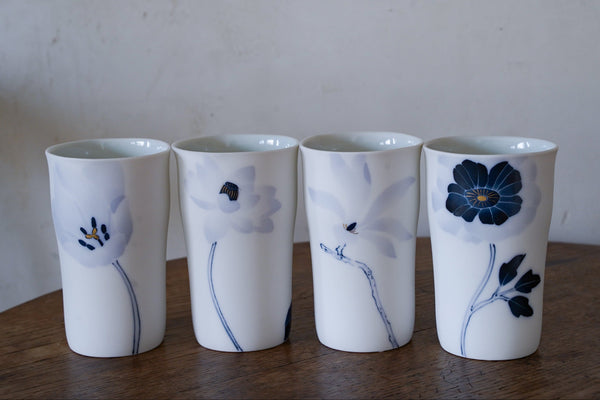
ABOUT THE MAKER
Singama
Founded in 1919, Shin Kiln is a pottery studio specializing in Seto sometsuke ware. Using the traditional Seto sometsuke technique of applying blue designs t...
MORE FROM THE MAKER
Singama
-
Makino | Seto Blue and White Glazed American Cup
Regular price ¥4,180Regular priceUnit price per -
Makura Kiln | Long Glass (M)
Regular price ¥4,950Regular priceUnit price per -
Makawan | Long Glass (L)
Regular price From ¥4,950Regular priceUnit price per


