

Toy Workshop | Lucky Dog
Toy Workshop | Lucky Dog
Shipping: ¥700 flat rate / half-price shipping on orders of ¥11,000 or more
Couldn't load pickup availability
FAQ
Is it microwave and dishwasher safe?
Most pieces can be used in the microwave and dishwasher. Please avoid both for pieces with gold or silver decoration, earthenware with crackle glaze, and figurines. Hand washing is recommended for long use.
Will it look exactly like the photo?
Each piece is fired one by one at the kiln, so color, glaze flow and size vary slightly. Please enjoy it as the character of handmade ware.
When will it ship?
Orders ship within 3–5 business days via Yamato Transport. We will email you when it ships.
How much is shipping?
Shipping is ¥700. Orders of ¥11,000 or more get half-price shipping.
What if it arrives broken?
Please email us (masukichi@hitotsuchi.jp) within 7 days of arrival. We will replace or refund it at our cost.
Can I see it in person?
Many pieces are on display at our shop, Masukichi, in Seto, Aichi.


These are “Koma-inu” dogs, symbols of prayers for safe childbirth and child-rearing.
The birth of a child is a joyful and auspicious occasion in any era.
Dogs are said to have easy labors and have long been considered symbols of safe childbirth.
Just as “Inu no Hi” visits to shrines are held, there is a long-standing custom of wrapping a maternity belt around the belly on the “Inu no Hi” of the fifth month, praying for safe childbirth, because dogs are believed to ward off evil spirits like komainu and protect babies.

The Fukun dog is on the left, and the Koma-inu dog is on the right. Both are dogs symbolizing prayers for safe childbirth.
[About the Product]
Product Name: Fukun Dog
Material: Ceramic
Size: Height 12.7cm x Width 16cm x Depth 7.8cm
Finish: Matte
Manufacturer: Seto Tougeisha (Toy Workshop)
The matte finish is achieved by painting with pigments on a pure white, unglazed surface that retains the texture of the clay.
As each one is hand-painted, the facial expressions vary slightly.
[Introducing Seto Tsukurite]
Experts in hand-painted ceramic figurines. Craftsmanship completed entirely in Seto.
 Photo: Mari Mizuno of “Seto Tougeisha” and her husband Yusuke Mizuno, producer of “Toy Workshop.”
“Toy Workshop” is a regional toy brand founded by “Seto Tougeisha,” a ceramic figurine workshop that has been in operation since 1951. This workshop handles everything from planning and prototyping to mold-making, casting, firing, and painting.
“Seto Tougeisha” began when Mari Mizuno’s grandfather started a ceramic figurine workshop catering to domestic demand. In the early days, the workshop was busy with orders for Kyoto Fushimi dolls, and it is said that Kyoto-bound shipments went out almost every week.
In Seto, the production of export goods increased from the Meiji era, and a system for mass-producing ceramic figurines was established. Items made in Seto were called “Seto Novelties,” and their elaborate shapes and delicate painting were highly acclaimed overseas. By the 1960s, more than 300 novelty-related companies had formed in the city, supporting Seto’s post-war craftsmanship.
Later, when the Plaza Accord was signed in 1985, the yen appreciated from 360 yen to the low 70s against the dollar, and most companies switched to different businesses. However, because “Seto Tougeisha” focused on production tailored to domestic demand, it received many orders from shrines and other institutions, and continues to operate today.
Original Regional Toy “Toy Workshop”

“Toy Workshop” is produced by Yusuke Mizuno, the eighth successor of the 250-year-old “Seto Hongyou Kiln,” who is Mari’s husband. Both come from families of ceramic artisans, and they continue to create modern products while valuing tradition and supporting one another.
“I decided to start Toy Workshop because I wanted to pass down traditional Japanese customs in a proper form. However, if I kept the motifs as they were, people wouldn’t take notice. So, I remade the colors of existing items and slightly redesigned them, releasing them as original brand regional toys. Since many people living in nuclear families may not know about old customs, I want to redefine them once again.” (Yusuke Mizuno)
As the eighth successor of “Seto Hongyou Kiln,” Yusuke usually creates vessels using Seto clay and natural glazes, working by hand on a potter’s wheel in a craft that has continued since the Edo period. In the midst of this, he is demonstrating his talent as a producer and creating new products through Toy Workshop!
The Toy Workshop Production Process

Toy Workshop designer Asuka Kifuku handles all the designs.
This is the original drawing. An in-house sculptor creates a prototype based on this two-dimensional drawing.
In the hands of a skilled sculptor, simply by looking at a single drawing, a three-dimensional Maneki-neko figure quickly emerges from the clay. Because ceramics shrink during firing, this is a meticulous process of creating the size while calculating the shrinkage percentage.
Once the prototype is finished, the next step is to have plaster molds made by an affiliated mold maker in the city for mass production.

This is the finished plaster mold.At “Seto Tougeisha,” products are made using a method called “slip casting,” where mud called “deisho” is poured into this plaster mold to form the ceramic piece.
 Pouring the deisho.
What is being poured here is a clay called “Byakko.” It was researched and developed at the former National Ceramic Research Institute in 1931 (Showa 6) and created to make novelty products for export.

Because plaster absorbs moisture, it hardens from the outside in. Once the deisho has dried to the required thickness, the mold is turned upside down, and the excess deisho is poured out. For this reason, it is also called “gaba casting.”
According to a veteran craftsman with over 20 years of experience, the speed and time for pouring the clay are carefully considered depending on the shape of the product, the season, and the weather, because “the clay is alive!” For large molds, it is left to dry for about 30 minutes.

Once it has hardened, the mold is removed.

The Maneki-neko figure has emerged! When it comes out of the mold, a line-like mark called a “flash” forms between the mold halves, so this is smoothed out.

The “flash” remaining after removing it from the mold is trimmed.

It is further smoothed with a damp cloth.

The work is done right behind the casting area.

It is fired in an electric kiln on the same floor at approximately 1,030 degrees.

After firing, it becomes pure white. Ceramic paints are then used to paint the design. There is no preliminary sketch; the design is painted all at once with a brush while looking at a sample.


It is complete!
[Handling Precautions]
・Please handle with care, as this is a fragile item.
・Please be careful with water, as it has not been fired after painting.
[Returns and Exchanges]
Each of these items is entirely handmade. Therefore, even slight variations in the thickness of lines may result in slightly different facial expressions. Thank you for your understanding.
We apologize for the inconvenience, but even if the item is unused, returns and exchanges due to differences in size, design, or color expectations will be subject to the customer bearing the round-trip shipping costs. Thank you for your understanding.
ABOUT THE MAKER
Gangu kobo
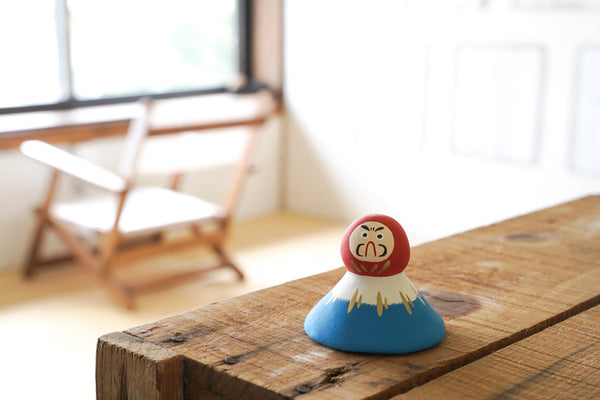
These ceramic lucky charms are made by Toy Factory, a traditional toy maker in Seto City, Aichi Prefecture. Seto artisans handcraft each piece, including ann...
MORE FROM THE MAKER
Gangu kobo
-
Toy Workshop | Good Fortune and Future Blessings (White)
Regular price ¥880Regular priceUnit price per -
Toy Workshop | Good Fortune & Future Blessings (Beige)
Regular price ¥880Regular priceUnit price per -
Toy Workshop | Good Fortune and Future Prosperity (Black)
Regular price ¥880Regular priceUnit price per -
Toy Workshop | Lucky Unearthly Bell (Ema)
Regular price ¥1,210Regular priceUnit price per


