


Rokubee Toen | Oribe Rice Bowl
Rokubee Toen | Oribe Rice Bowl
Shipping: ¥700 flat rate / half-price shipping on orders of ¥11,000 or more
Couldn't load pickup availability
FAQ
Is it microwave and dishwasher safe?
Most pieces can be used in the microwave and dishwasher. Please avoid both for pieces with gold or silver decoration, earthenware with crackle glaze, and figurines. Hand washing is recommended for long use.
Will it look exactly like the photo?
Each piece is fired one by one at the kiln, so color, glaze flow and size vary slightly. Please enjoy it as the character of handmade ware.
When will it ship?
Orders ship within 3–5 business days via Yamato Transport. We will email you when it ships.
How much is shipping?
Shipping is ¥700. Orders of ¥11,000 or more get half-price shipping.
What if it arrives broken?
Please email us (masukichi@hitotsuchi.jp) within 7 days of arrival. We will replace or refund it at our cost.
Can I see it in person?
Many pieces are on display at our shop, Masukichi, in Seto, Aichi.


Vessels crafted by a 92-year-old master potter still at the wheel.
Akutsu ware is a traditional craft made by a long-established pottery studio known to those in the know. This studio is filled with the desire for people to use authentic Akutsu ware at their everyday dining table.

A simple rice bowl featuring distinctive Oribe glaze

White camellia flowers
The Oribe glaze has a clearly defined rim, and its depth gives it a glossy, shimmering appearance like an aurora.
The beautiful contrast between the white camellia and the green Oribe glaze enhances the food.

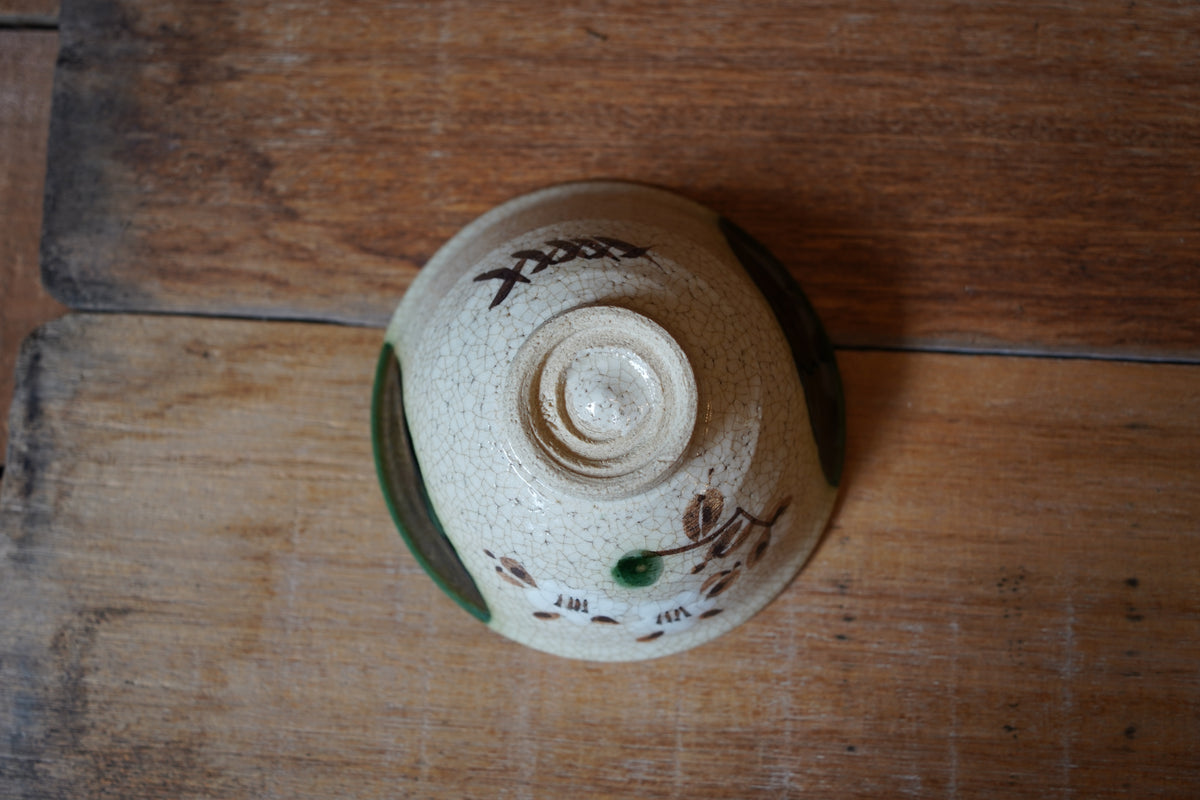
Camellia flowers also adorn the base
The warm, irregular shape of the hand-crafted vessel feels just right when held in both hands.
The scattered crazing is also a natural occurrence that cannot be controlled by people or machines.
[About the Product]
Name: Oribe Rice Bowl
Material: Ceramic
Size: Approx. 12.5 cm in diameter × 6.0 cm in height
Microwave: Safe
Dishwasher: Not recommended (but usable)
Oven: Not suitable
Manufacturer: Rokubei Toen
※Size and capacity may vary slightly as each piece is made individually on the potter's wheel. Please use these measurements as a general guide.
[Care Instructions for First Use]
Before first use, boil the vessel in rice-washing water for about 3 minutes. During the initial period of use, the piece will absorb moisture readily. Avoid leaving drinks in it for extended periods or placing it immediately into a cupboard, as residual moisture may cause mold. If mold appears, it will only be on the surface, so simply wash it off. It is harmless and will disappear with continued use.
This work is done entirely with natural materials. No harmful chemicals such as lead or cadmium are used, and the glaze and clay are prepared using traditional methods. We hope you will understand the inherent nature of clay.
[Return and Exchange Policy]
For returns or exchanges due to customer convenience, the customer is responsible for round-trip shipping costs. Even if the item is unused, returns or exchanges due to differences in size, design, or color from what was expected will be considered a customer-convenience return. Please note that the color and texture of the product may differ slightly from the actual item depending on your browser, monitor performance, and settings.
[Introducing Seto no Tsukurite]
Traditional craft vessels for everyday life. Rokubei Toen, founded in 1742.

The Akutsu district in Seto City, Aichi Prefecture, is home to a particularly large concentration of historic pottery studios. Along narrow lanes are pottery studios, ceramic artists, and wholesalers, and Rokubei Toen is located in this area, which still retains the distinctive atmosphere of a "pottery village."
The studio was founded in 1742, during the Kanpo era of the Edo period. It produces Akutsu ware, which is designated as a traditional Japanese craft. While the glaze is made and the pottery is crafted using traditional hand techniques such as the potter's wheel and hand-painting, its affordable price makes it easy to use in everyday life. We visited the studio, where 92-year-old master potter Yamauchi Sagawa, who was selected as one of Japan's Modern Master Artisans, is still active at the wheel.
"We are not artists; we are craftsmen."

Rokubei Toen is a long-established pottery studio known to those in the know.
It rarely sells directly to retailers, instead producing commercial tableware and wholesale orders by hand, with a particular specialty in wheel-thrown pottery.
The studio produces Akutsu ware, a traditional Japanese craft.
Its history is long, with origins said to date back to the Nara period (around 700). In the Kamakura period, Japan's first glazed pottery was produced, and Akutsu ware is distinguished by its use of seven traditional glazes: Oribe, Shino, Kokesai, Fuka, and others.
Among these, the deep green Oribe vessels of Rokubei Toen are particularly striking.

On the left is Masutaro Minami, representative of Masukichi; on the right is Daigo Kato, the 27th head of Rokubei Toen.
"We are craftsmen, not artists. When asked for something like this, we think about how to make it at a lower cost. We have continued to use the same techniques for generations, and now that consistency has become one of our hallmarks."
While valuing traditional handcraftsmanship, the studio is highly flexible in responding to orders from wholesalers and restaurants. For example, if asked, "Can you make it without crazing?" they will adjust their technique to maintain the Oribe color while eliminating the crazing.
Crazing is one of the defining features of Oribe glaze. The idea of making it without crazing might sound absurd, but the studio considers whether it can produce what is required at the expected price.
Dedication to Clay and Glaze

The studio purchases clay from a supplier, using the "crazing clay" commonly used in Seto and the "Gotomaki" clay from neighboring Gifu Prefecture, which has been favored since the Momoyama period. This clay is homogenized using a machine powered by electricity that was built by the craftsmen working here nearly 70 years ago.
Because clay is a natural material, it varies depending on the layer from which it was extracted. The beauty of the glaze depends on the compatibility between the clay and the glaze. This extra step is taken to minimize those variations as much as possible.
Making Oribe Deeper and More Beautiful

Copper is used in the Oribe glaze, which is thenfired in an oxidizing atmosphere.This causes the glaze to react with the air and develop a slightly oxidized film, which can dull its appearance. To remove this, the pieces are soaked overnight in "tochi-shibu" (persimmon tannin) mixed with plenty of acorn caps and then dried in the sun, bringing out a more vivid color.

This is the tochi-shibu. Acorn caps are collected in a 45-liter bag and soaked in water.Soaking the pieces in this tochi-shibu accentuates the crackle patterns known as crazing and brings out the distinctive character of Oribe.

Furthermore, the brown iron designs often seen on Oribe vessels are painted with iron-rich pigment. This is made from a raw material called "kiban," which is mined from mountains and contains iron.

Kiban, the raw material for the iron designs.

Finely groundand mixed with water.

The pale purple is an Oribe glaze made with copper. In this way, the studio continues to make traditional pottery while carefully preserving the materials that have been used since ancient times.
93-year-old master potter Yamauchi Sagawa, one of Japan's Modern Master Artisans

The craftsman who supports Rokubei Toen is master potter Yamauchi Sagawa. A living legend, he has been working at the potter's wheel in this studio for nearly 80 years.
His career has been exceptionally distinguished. At age 43, he won first place by a wide margin at the National Hand-Throwing Pottery Competition. He was selected as one of Japan's Modern Master Artisans at age 75 and received the Yellow Ribbon Medal at age 77.
He is truly one of Japan's leading master potters.
"You can't keep working once your hearing goes. I can still hear and see. There isn't anyone else still doing this at 93."
On the rapidly spinning potter's wheel, a lump of clay instantly rises into a cylindrical shape. When he applies a measuring tool called a tonbo to even the thickness and check the size, the height and rim diameter are perfectly precise. His hands move naturally, as if he were simply taking a breath, and the piece becomes a teacup.
His movements show no sign of his age of 93.
300 pieces a day is considered a full day's work. The craftsman's attitude of "making anything"

Sagawa became an apprentice at age 14.
He originally lived near the studio, and his family also had a history of pottery. However, his father died early, so he left junior high school to start working.
Every day, from 7 a.m. to 10 p.m., he worked as an apprentice.
Just as a long day seemed to end, this was when Sagawa's real practice at the potter's wheel began. In the past, there was no one to teach him, and it was a time when "you learn by watching."
Speed was important, of course, but he also had to make sake bottles precisely to 200 ml or 220 ml. Making 300 of them a day was considered a full day's work.
At age 16, he began studying the tea ceremony and flower arranging, saying, "Someone who doesn't know the tea ceremony or flower arranging probably can't make tea utensils or flower vessels." He later became a master of both. His dedication to mastering the art of pottery as a master potter is evident.
Finally, he became able to make 300 pieces a day, and his talent quickly came to the fore when he turned 20.
When wholesalers asked, "Can you make something like this?" he responded immediately. Even difficult shapes were no problem. As soon as an order came in, he would quickly produce the required quantity.
"A lot of tea utensils were selling. Business was booming. For a master potter, you make your living by how much you can make each piece for. You can't make a living by making just a few. You have to make anything."

His ability to continuously provide high-quality products born from his technical skill is what continues today at Rokubei Toen.
"I wondered if my skills had declined. I tried to see how many I could make in an hour, and I could still make 130." He says this with a smile, but it is unlikely that anyone will ever be able to make this many again.
Kato also trained as a master potter in Kyoto,
"But as long as Mr. Sagawa is here, there is no room for me! Mr. Sagawa makes 400 to 500 pieces a day." He says, and we are simply amazed by his overwhelming production capacity.
"I have responsibilities, so I can't quit"—The power of working for life

Sagawa, who is always working with his hands, appears incredibly energetic and full of vitality. However, at age 91, his kidney function deteriorated, and he now undergoes dialysis three times a week.
Even so, Sagawa says, "I have responsibilities, so I can't quit."
In those words, we felt the power of a man who would work for life, both as a master potter and as someone who has supported Rokubei Toen.
The pricing at Rokubei Toen is not a matter of low quality for a low price, but is possible only because of the skilled craftsmanship that boasts exceptional speed and precision.
This studio is filled with the desire for people to use authentic Akutsu ware at their everyday dining table.
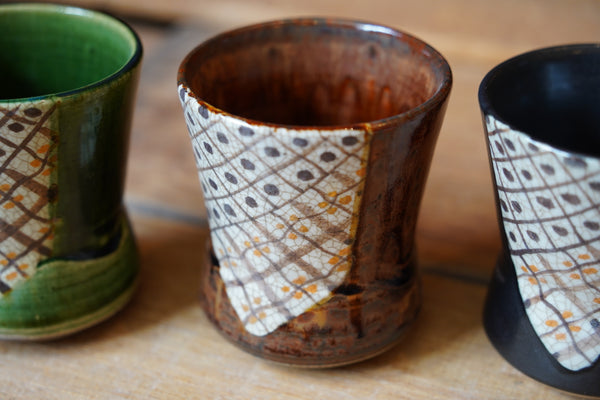
ABOUT THE MAKER
Rokubee Toen
Established in 1742, Rokubee Toen is a pottery studio in Akazu, Seto City, Aichi Prefecture. As a producer of Akazu ware, the studio offers Oribe rice bowls ...
MORE FROM THE MAKER
Rokubee Toen
-
Rokubei Toen | Free Cup
Regular price ¥2,420Regular priceUnit price per -
Rokubei Toen | Free Cup Yayoshida
Regular price ¥2,420Regular priceUnit price per -
Rokubei Toen | Cup & Saucer
Regular price ¥3,860Regular priceUnit price per -
Rokubei Toen | Sake Cup
Regular price From ¥1,210Regular priceUnit price per


