


M.M.Yoshihashi | Chorituke Cup (Large)
M.M.Yoshihashi | Chorituke Cup (Large)
Shipping: ¥700 flat rate / half-price shipping on orders of ¥11,000 or more
Couldn't load pickup availability
FAQ
Is it microwave and dishwasher safe?
Most pieces can be used in the microwave and dishwasher. Please avoid both for pieces with gold or silver decoration, earthenware with crackle glaze, and figurines. Hand washing is recommended for long use.
Will it look exactly like the photo?
Each piece is fired one by one at the kiln, so color, glaze flow and size vary slightly. Please enjoy it as the character of handmade ware.
When will it ship?
Orders ship within 3–5 business days via Yamato Transport. We will email you when it ships.
How much is shipping?
Shipping is ¥700. Orders of ¥11,000 or more get half-price shipping.
What if it arrives broken?
Please email us (masukichi@hitotsuchi.jp) within 7 days of arrival. We will replace or refund it at our cost.
Can I see it in person?
Many pieces are on display at our shop, Masukichi, in Seto, Aichi.


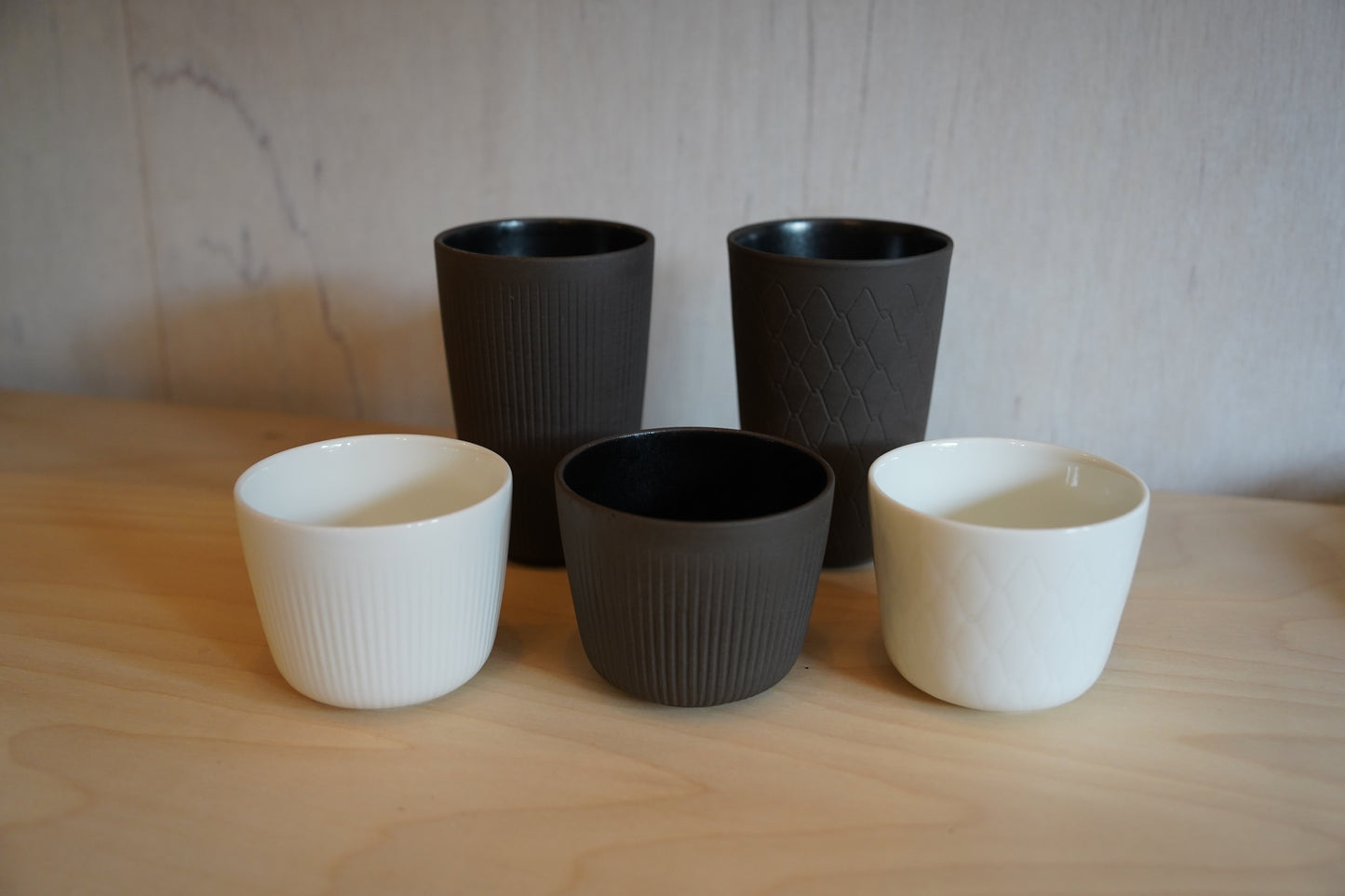
Simple and Everyday-Friendly “Jikusa” and “Tsuna” Designs
Cups featuring simple engraved patterns.
Adorned with the auspicious “jikusa” and “tsuna” patterns that have long been considered good luck.
The chic, matte “black clay” finish is perfect for any occasion.
Suitable for use anywhere.

The jikusa pattern, based on a small bamboo-like plant.
This pattern has been cherished since the Edo period as a symbol of growth and prosperity, inspired by the plant’s straight, upward growth.

A beautiful, flowing net pattern.
It symbolizes good fortune, with the belief that “a net can hold happiness” and “a net is always tied and never comes undone.”

Different patterns that coordinate simply.
They add an elegant touch to any beverage you pour.

Available in two sizes: small in front, large in back.
Simple cups that blend into any setting. Their auspicious patterns also make them perfect as gifts.
[About the Product]
Product Name: Engraved Cup (Large)
Material: Porcelain (Black Clay)
Size: Height 12.2 cm, Diameter 8.2 cm
Finish: Matte
Manufacturer: M.M.Yoshihashi / Designed by YACHT
【Precautions】
・There may be slight variations in size and color.
・ Colors may appear different depending on your computer settings.
・This product may break if subjected to strong impact. It may cause cuts or other injuries, so please handle with care.
・Do not drag the product across tables or other surfaces, as this may cause scratches.
・After use, wash immediately and allow to dry thoroughly before storing. Failure to do so may cause mold or other issues.
・Please do not use in a dishwasher, as this may cause damage.
・Cleaning overglaze products with steel wool or abrasive cleaners may cause the decoration to peel or become scratched.
[Introducing Seto no Tsukurite]
Unique creations that make full use of the expertise of a “kata-ya” (mold maker): M.M.Yoshihashi

“M.M.Yoshihashi” began as a “kata-ya” in the Shinano district of Seto City in 1959. A kata-ya is a specialist in the molds used for mass-producing pottery.
Today, Kenichi Yoshihashi, the third generation to carry on the family business, makes full use of the mold-making techniques cultivated over generations, commissioning kilns to manufacture highly distinctive products.
What does a kata-ya do?

A kata-ya’s work begins with drawing a design.

Based on the design, plaster is carved to create the original model. Because clay, molding, firing, and kiln types all affect shrinkage and deformation, extensive experience and knowledge are required.※Pottery shrinks when fired in a kiln.

The one in front is called the “original model,” and plaster is poured into the original model to create a mold.
The one in back is called a “case,” and it is a mold used to create many molds. It is a mold for mass-producing molds.

Once these are complete, the “production mold” used by the kiln is born. This is a mold for mass-producing pottery. To mass-produce, several molds must be in operation at once, so the required number is manufactured.
This “production mold” is reportedly made by adjusting the type of plaster and the moisture content to suit the molding method and the characteristics of the kiln.

The original model and production mold for the best-selling Trace Face Knit Wear.
The origin of M.M.Yoshihashi's unique creations
 A goldfish aroma stone and TeruTeruVASE.
At M.M.Yoshihashi, in addition to original designs by Kenichi Yoshihashi, there are many collaborations with designers, and challenging, unique items continue to emerge one after another.
Despite this, when Yoshihashi was in high school, he reportedly decided, “I will never take over the family business!” To get as far away as possible from his parents, he went to a national university in the Chugoku region. However, he realized that this was not where the young Yoshihashi belonged. Without telling his parents, he dropped out of university and enrolled in a fashion school in the metropolis of Tokyo.

“At the vocational school, I worked hard studying patternmaking, which involves creating patterns for clothing. I found it incredibly enjoyable to work with the very foundation of clothing—the part everything else is based on. But when I went home and looked at my parents’ work again, I realized we were doing the same thing.”
Yoshihashi says this with a smile. Although clothing and finished pottery are different, he realized that drawing designs and creating three-dimensional objects was the same work, and that is why he decided to take over the family business.
After returning at age 28, he thought, “If I can make my own molds, why shouldn’t I start my own brand?” He now makes his own molds and collaborates with kilns to create products.

Many of the items created by Yoshihashi are exciting and add joy to everyday life.
At the same time, recognizing that the number of “kata-ya” in the industry is steadily declining, he launched “Kata no Gakkou” and holds workshops on plaster molds for artists and those involved in ceramics.He is also working to promote the craft more widely, hoping that even a little interest might inspire someone to become an artisan.
The future of the “kata-ya” that supports pottery production areas.
We hope you will continue to follow their journey!

ABOUT THE MAKER
M.M.Yoshihashi
Based in Seto City, Aichi Prefecture, M.M.Yoshihashi creates products utilizing the techniques of a “kata-ya,” a traditional workshop that makes pottery mold...
MORE FROM THE MAKER
M.M.Yoshihashi
-
M.M.Yoshihashi | TETANPO (Little Bird)
Regular price ¥4,400Regular priceUnit price per -
M.M.Yoshihashi | Trace Face cup Knit wear
Regular price ¥3,080Regular priceUnit price per -
M.M.Yoshihashi | Trace Face cup Rattan Basket
Regular price ¥3,080Regular priceUnit price per -
M.M.Yoshihashi | Chorituke Cup (Small)
Regular price ¥1,980Regular priceUnit price per


