

Kashiwa Kiln | Kamayaki no Komichi Series Rectangular Chopstick and Cutlery Rest
Kashiwa Kiln | Kamayaki no Komichi Series Rectangular Chopstick and Cutlery Rest
Shipping: ¥700 flat rate / half-price shipping on orders of ¥11,000 or more
Couldn't load pickup availability
FAQ
Is it microwave and dishwasher safe?
Most pieces can be used in the microwave and dishwasher. Please avoid both for pieces with gold or silver decoration, earthenware with crackle glaze, and figurines. Hand washing is recommended for long use.
Will it look exactly like the photo?
Each piece is fired one by one at the kiln, so color, glaze flow and size vary slightly. Please enjoy it as the character of handmade ware.
When will it ship?
Orders ship within 3–5 business days via Yamato Transport. We will email you when it ships.
How much is shipping?
Shipping is ¥700. Orders of ¥11,000 or more get half-price shipping.
What if it arrives broken?
Please email us (masukichi@hitotsuchi.jp) within 7 days of arrival. We will replace or refund it at our cost.
Can I see it in person?
Many pieces are on display at our shop, Masukichi, in Seto, Aichi.


The pottery-making region and a famous spot in Seto are featured in the design.
Kashiwa Kiln creates items with a vintage-like texture rooted in Nordic design. This set of chopstick and cutlery rests from the "Kama-gaki no Komichi Series" is inspired by the famous spot in Seto City, Aichi Prefecture, a renowned pottery-making region, known as "Kama-gaki no Komichi."

A pattern and texture reminiscent of Kama-gaki no Komichi.

It comes in an original Kashiwa Kiln box, making it ideal as a gift.
 The famous spot in Seto, "Kama-gaki no Komichi."
“Kama-gaki” refers to stone-like walls built by stacking kiln tools that were once used in climbing kilns. Seto was once known for firing large quantities of pottery in climbing kilns. To fit more pottery inside, tools such as supports, pillars, and covers to prevent the stacks from collapsing were used.
Because kiln tools were used repeatedly inside the climbing kiln, they gradually weakened and eventually became unusable when they developed cracks or broke. However, pottery fired at 1,300 degrees Celsius does not burn. This meant that once they had served their purpose, they would become industrial waste. To make effective use of them, the artisans of the time turned them into kama-gaki.
Stacked into geometric patterns by the artisans, they have become a rare sight that can only be seen in Seto today. Like kama-gaki, this pottery increases in value over time.
It is a piece that truly grows more valuable with age.
[About the Product]
Product Name: Chopstick and Cutlery Rest / 2-Piece Set G61 from the Kama-gaki no Komichi Series
Material: Ceramic
Size: Depth 2.0 cm × Width 9.0 cm × Height 0.9 cm (1 piece)
Microwave and dishwasher safe
Oven use: Not permitted
Manufacturer: Kashiwa Kiln
[Return and Exchange Policy]
For returns or exchanges due to customer convenience, the customer is responsible for the round-trip shipping costs. Even if the item is unused, returns or exchanges due to differences in size, design, or color from what was expected will be considered a customer return. Please note that the product's color may differ from the actual item depending on your browser, monitor performance, and settings. As each piece has a unique finish, please purchase with this in mind.
[About Tsukurite]
Rooted in Nordic design, Kashiwa Kiln creates items that are cherished for years to come.
Kashiwa Kiln was founded in 1965 in the Horo district of Seto City, Aichi Prefecture. It stands quietly along the path of "Kama-gaki no Komichi," where many artisans once came and went.
In a workshop that harmonizes with nature, the kiln creates long-lasting pieces rooted in Nordic design. Discover the secret behind its distinctive nostalgic world.
The Beginnings of Kashiwa Kiln
 Kashiwa Kiln began when the first generation, Hisayuki Iwatsuki, who was born in Okazaki City, Aichi Prefecture, moved to Seto to become a ceramic artist.
At the time, Seto was highly active in making dolls for overseas markets, known as "Seto Novelties," and Hisayuki found employment at a manufacturer. There, he learned the basics of becoming a model maker who creates the prototypes for dolls, and he became independent at the age of 26.
 At that time, Nordic design was in its golden age, and he was particularly influenced by the Finnish designer Kaj Franck.
Designs that can be made continuously and last forever.
Not luxury goods, but items within reach.
To bring these to life, he began creating small batches and semi-mass-produced items by making the models himself, creating molds, and using a technique called casting, where slip is poured into the molds.
Later, a trading company in Nagoya took notice, and exports increased rapidly, primarily to the U.S. West Coast and Northern Europe. The kiln also began producing OEM products for well-known companies.
"The Glaze Paints the Picture"

Kashiwa Kiln uses red clay found in Seto. Hisayuki uniquely refined it so that it remains soft and gradually warps during the firing process.Furthermore, he spent about two years developing his own glaze, creating it so that uneven firing and scorching highlight the relief patterns.

When mass-producing, uniformity is often required, but the kiln deliberately creates unevenness. Even when fired in the same kiln, the way the flames hit creates variations in firing, color, and shape, giving each piece the special feel of a one-of-a-kind item.
"The blend of clay and glaze is the foundation of Kashiwa Kiln. The glaze paints a picture inside the kiln."
These are the words of the second-generation owner, HisatoIwatsuki.
We are also fascinated by this mysterious glaze, and we feel a sense of excitement every time a product arrives and we open the box. Our customers feel the same way, and when purchasing from our store, they carefully compare the pieces before choosing.
Something that will always be by your side
While continuing to create works like those made by the first generation, Hisato also releases new pieces with a vintage-like texture.
Like architecture that blends into the cityscape, pieces that melt into your living space.
Pieces you can enjoy as they change over time and continue to cherish.
This kiln is highly recommended to anyone whoshares these values.
ABOUT THE MAKER
Kashiwa Kiln
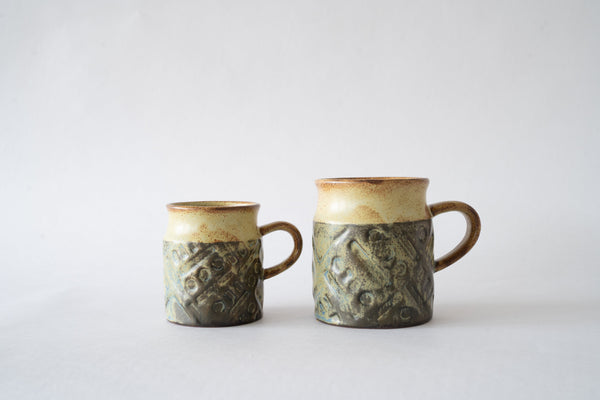
Kashiwa Kiln is a pottery studio in Seto City, Aichi Prefecture, rooted in Scandinavian design. In addition to mugs, plates, and chopstick rests from its "Ka...
MORE FROM THE MAKER
Kashiwa Kiln
-
Kashiwa Kiln | Kamigaki no Komichi Series Mug (S)
Regular price ¥2,200Regular priceUnit price per -
Kashiwa Kiln | Kamigaki no Komichi Series Mug (L)
Regular price ¥2,750Regular priceUnit price per -
Kashiwa Kiln | Kamogaki no Komichi Series Plate/Saucer (SS)
Regular price ¥1,595Regular priceUnit price per -
Kashiwa Kiln | Kamigaki no Komichi Series Plate & Saucer (S)
Regular price ¥1,650Regular priceUnit price per


