


Toy Workshop | Lucky Cat (Large)
Toy Workshop | Lucky Cat (Large)
Shipping: ¥700 flat rate / half-price shipping on orders of ¥11,000 or more
Couldn't load pickup availability
Your items go in our original paper box made with Tani Shiki in Seto. Pairs are separated with a divider. We choose the box size.
FAQ
Is it microwave and dishwasher safe?
Most pieces can be used in the microwave and dishwasher. Please avoid both for pieces with gold or silver decoration, earthenware with crackle glaze, and figurines. Hand washing is recommended for long use.
Will it look exactly like the photo?
Each piece is fired one by one at the kiln, so color, glaze flow and size vary slightly. Please enjoy it as the character of handmade ware.
When will it ship?
Orders ship within 3–5 business days via Yamato Transport. We will email you when it ships.
How much is shipping?
Shipping is ¥700. Orders of ¥11,000 or more get half-price shipping.
What if it arrives broken?
Please email us (masukichi@hitotsuchi.jp) within 7 days of arrival. We will replace or refund it at our cost.
Can I see it in person?
Many pieces are on display at our shop, Masukichi, in Seto, Aichi.


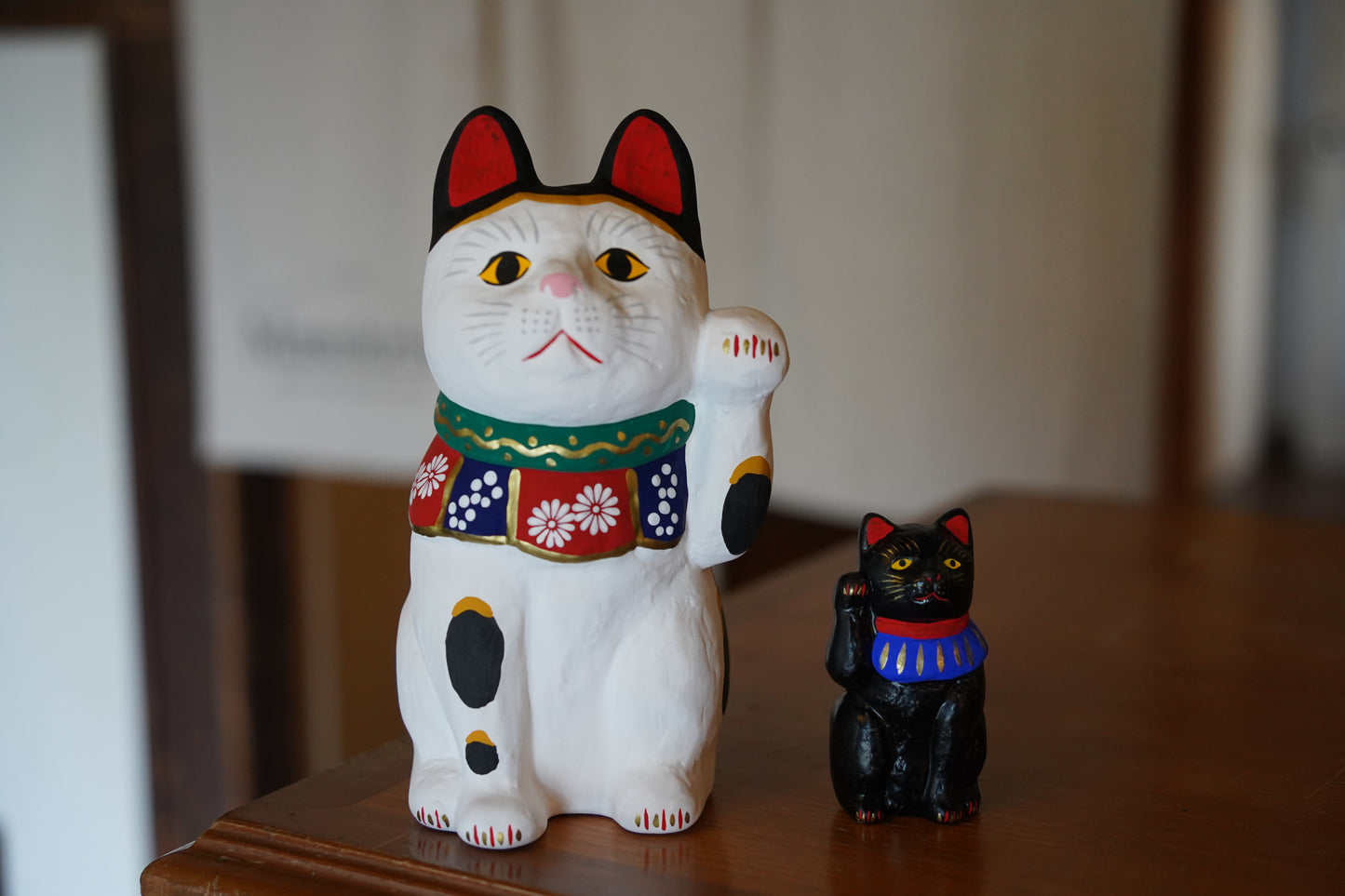
The beckoning cat, said to have originated in the Edo period as a lucky charm believed to invite good fortune.
While beckoning cats come in various colors, black cats have long been called "lucky cats" in Japan because they can see well even at night, and are considered symbols of good luck and protection against evil.

Large on the left, small on the right.
[About the Product]
Product Name: Toya Kobo | Beckoning Cat (Large)
Material: Ceramic
Size: Height 17.8 x Width 9.2 x Depth 10.4 cm
Finish: Matte
Manufacturer: Seto Tougeisha (Toya Kobo)
The matte finish is painted with pigments on a pure white, unglazed surface that retains the texture of the clay.
As everything is hand-painted, each face varies slightly.
[Introducing Seto Tsukurite]
Experts in hand-painted ceramic figurines. Craftsmanship completed entirely in Seto.
 Photo: Mari Mizuno of "Seto Tougeisha" and her husband Yusuke Mizuno, producer of "Toya Kobo".
"Toya Kobo" is a regional toy brand established by "Seto Tougeisha", a ceramic figurine workshop that has been in operation since 1951. This workshop handles everything from planning and prototyping to mold-making, casting, firing, and painting.
"Seto Tougeisha" began when Mari Mizuno's grandfather started a ceramic figurine workshop for the domestic market. In the early days, the workshop was busy with orders for Kyoto Fushimi dolls, and it is said that Kyoto-bound shipments went out almost every week.
In Seto, production of export products also increased during the Meiji era, and a system for mass-producing ceramic figurines was established. Items made in Seto were called "Seto Novelties", and their elaborate shapes and delicate painting were highly acclaimed overseas. By the 1960s, over 300 novelty-related companies had formed in the city, supporting Seto craftsmanship after the war.
Later, when the Plaza Accord was signed in 1985, the yen appreciated from 360 yen to the dollar to the 70-yen range, and most companies switched to different businesses. However, because "Seto Tougeisha" focused on production for the domestic market, it received many orders from shrines and other institutions, and continues to operate today.
Original Regional Toy "Toya Kobo"

"Toya Kobo" is produced by Yusuke Mizuno, the eighth-generation successor of the 250-year-old "Seto Hongyokama" and husband of Mari Mizuno. Both come from families of ceramic artisans and continue to create modern products while preserving tradition with mutual support.
"The reason I decided to start Toya Kobo was that I wanted to pass down traditional Japanese customs in a proper form. However, if we kept the motifs as they were, people wouldn't look back. So, I remade the colors of existing items or gave them a slight redesign, and presented them as original brand regional toys. Since many people living in nuclear families may not know about old customs, I want to redefine them once again." (Yusuke Mizuno)
As the eighth-generation successor of "Seto Hongyokama", Yusuke usually creates vessels using Seto clay and natural glazes, working by hand on a potter's wheel. In the midst of this, he is demonstrating his talent as a producer and creating new products through Toya Kobo!
"The Toya Kobo Production Process"

Toya Kobo designer Asuka Kifushiro handles all the designs.
This is the original drawing. A full-time sculptor creates the prototype based on this two-dimensional drawing.
In the hands of a skilled sculptor, a three-dimensional beckoning cat emerges from a single picture in no time. Since ceramics shrink during firing, this is a meticulous process of creating the size while calculating that shrinkage percentage.
Once the prototype is finished, a plaster mold is made by a partner mold maker in the city for mass production.

This is the finished plaster mold.At "Seto Tougeisha", products are made using a method called "slip casting", where mud called "deisho" is poured into this plaster mold to form the ceramic.
 Pouring the slip.
What is being poured here is a clay called "Byakko". It was researched and developed at the former National Ceramic Research Institute in Showa 6 (1931) and created to make novelty products for export.

Plaster has a property of absorbing moisture and hardens from the outside slip. Once the dried slip reaches the necessary thickness, the mold is turned upside down, and the excess slip is poured out. For this reason, it is also called "gaba casting".
According to a veteran craftsman with over 20 years of experience, the speed and time of pouring the clay are carefully considered depending on the shape of the product, season, and weather, because "the clay is alive!" For large molds, it is dried for about 30 minutes.

Once it has hardened, the mold is removed.

The shape of the beckoning cat has emerged! When it comes out of the mold, a line-like mark called a "flash" can form between the mold halves, so this is smoothed out.

The "flash" remaining after removing it from the mold is trimmed.

It is finished even smoother with a wet cloth.

The work is done right behind the casting site.

It is fired in an electric kiln on the same floor at approximately 1,030 degrees.

After firing, it becomes pure white. Ceramic paint is then used to paint the design on this surface. There is no underdrawing, and it is painted all at once with a brush while looking at a sample.


It is complete!
[Handling Precautions]
・Please handle with care as it is fragile.
・Please be careful with water, as it has not been fired after painting.
[Notes on Returns and Exchanges]
Each of these products is entirely handmade. Therefore, even slight differences in line thickness may result in slightly different facial expressions. Thank you for your understanding.
We apologize for the inconvenience, but even for unused items, returns and exchanges due to differences in size, design, or color expectations will be at your expense for round-trip shipping. We kindly ask for your understanding.
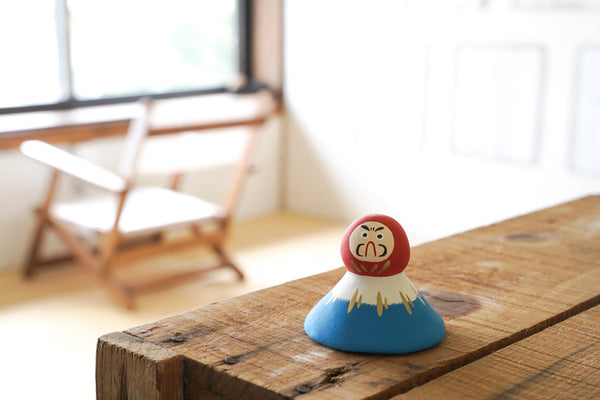
ABOUT THE MAKER
Gangu kobo
These ceramic lucky charms are made by Toy Factory, a traditional toy maker in Seto City, Aichi Prefecture. Seto artisans handcraft each piece, including ann...
MORE FROM THE MAKER
Gangu kobo
-
Toy Workshop | Good Fortune and Future Blessings (White)
Regular price ¥880Regular priceUnit price per -
Toy Workshop | Good Fortune & Future Blessings (Beige)
Regular price ¥880Regular priceUnit price per -
Toy Workshop | Good Fortune and Future Prosperity (Black)
Regular price ¥880Regular priceUnit price per -
Toy Workshop | Lucky Unearthly Bell (Ema)
Regular price ¥1,210Regular priceUnit price per


