


Tsubaki Kiln | IZUMI Oval Plate
Tsubaki Kiln | IZUMI Oval Plate
Shipping: ¥700 flat rate / half-price shipping on orders of ¥11,000 or more
Couldn't load pickup availability
Your items go in our original paper box made with Tani Shiki in Seto. Pairs are separated with a divider. We choose the box size.
FAQ
Is it microwave and dishwasher safe?
Most pieces can be used in the microwave and dishwasher. Please avoid both for pieces with gold or silver decoration, earthenware with crackle glaze, and figurines. Hand washing is recommended for long use.
Will it look exactly like the photo?
Each piece is fired one by one at the kiln, so color, glaze flow and size vary slightly. Please enjoy it as the character of handmade ware.
When will it ship?
Orders ship within 3–5 business days via Yamato Transport. We will email you when it ships.
How much is shipping?
Shipping is ¥700. Orders of ¥11,000 or more get half-price shipping.
What if it arrives broken?
Please email us (masukichi@hitotsuchi.jp) within 7 days of arrival. We will replace or refund it at our cost.
Can I see it in person?
Many pieces are on display at our shop, Masukichi, in Seto, Aichi.


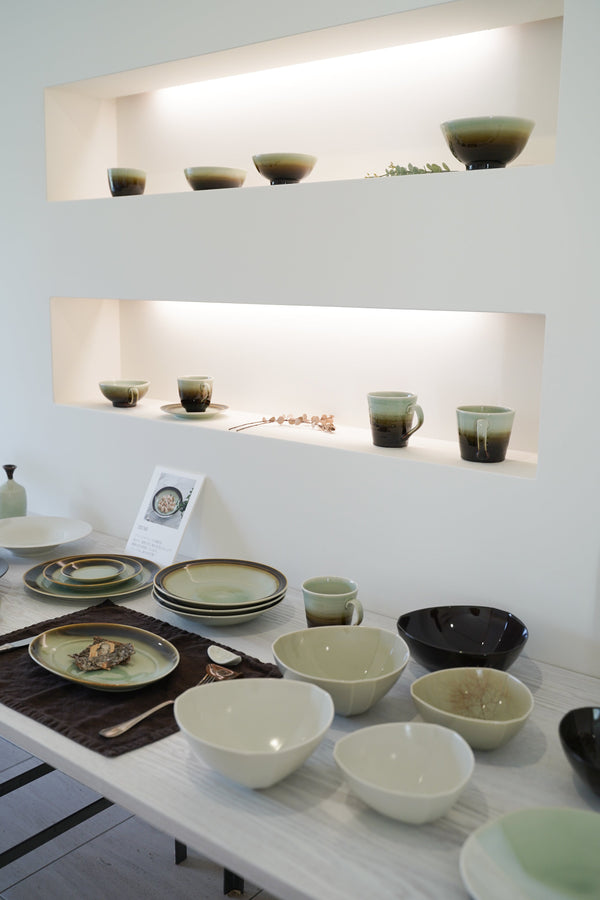
The “Ash Glaze Series,” inspired by “Ko-Seto” and made with natural wood ash
Modern vessels that emphasize generous negative space.Their simple, warm appearance, created with natural wood ash glazes,complements any dish.
The white glaze is made primarily from the ash of the Japanese camphor tree, while the green glaze is made mainly from pine ash, a material that symbolizes Tsubaki Kiln.The black glaze is made from a variety of wood ashes with added iron, resulting in a lustrous, transparent brown. These three ash glazes are used to create the vessels in the “Ash Glaze Series.”
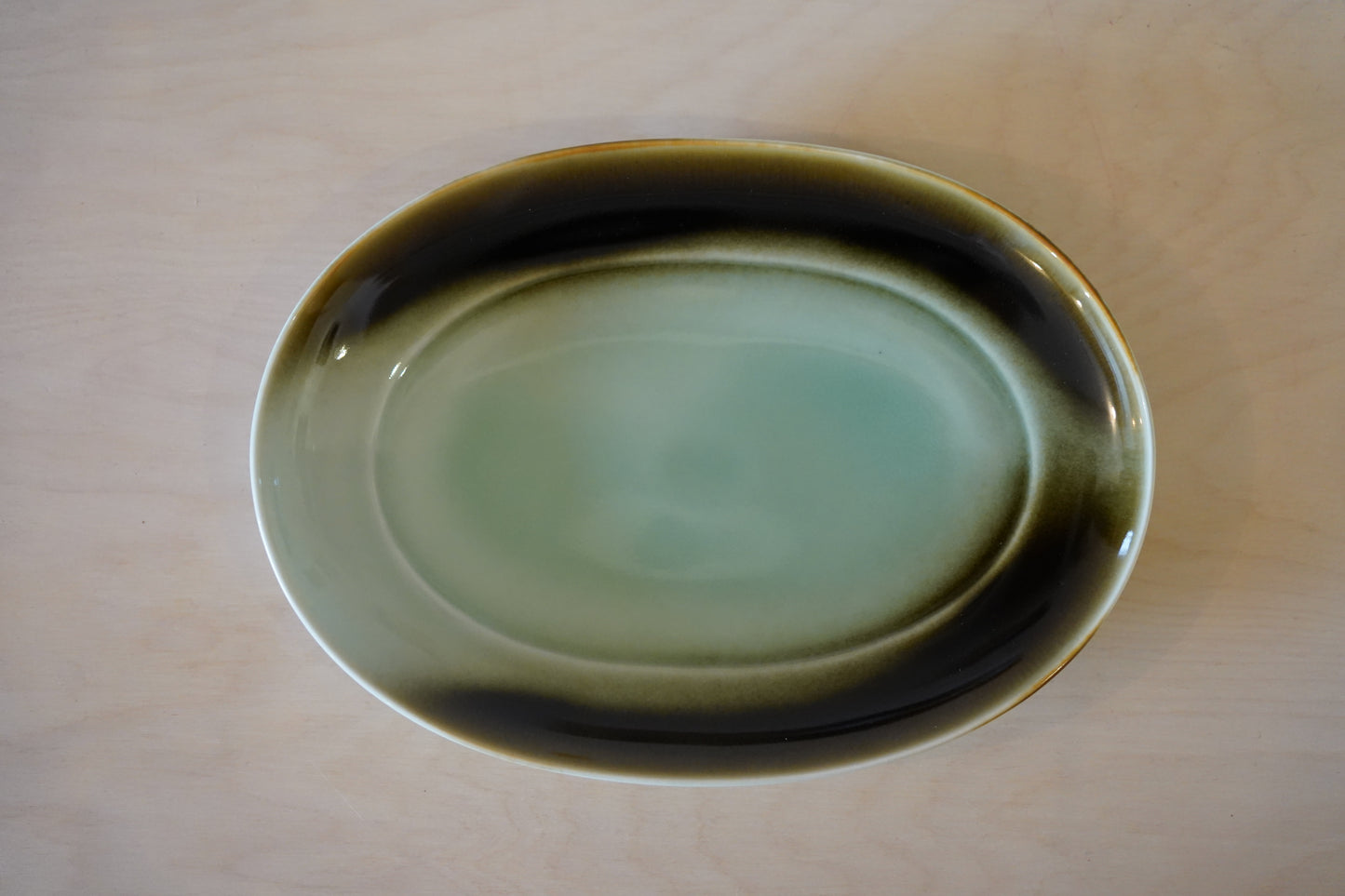
The IZUMI Series features green glaze with black glaze sprayed on for color.

The soft outline of the sprayed black glaze is beautiful.

The underside.

Viewed from above.
[About the Product]
Product Name: IZUMI Oval Plate
Material: Porcelain
Size: 25.4 cm (W) × 18.2 cm (L) × 2.8 cm (H)
Microwave: Safe
Dishwasher: Safe
Oven: Not suitable
Manufacturer: Tsubaki Kiln
※As each piece is handcrafted at every stage of production, there may be slight variations in color and shape. We hope you enjoy these unique differences.
[Return and Exchange Policy]
For returns or exchanges due to customer convenience, the customer is responsible for round-trip shipping costs. Even if the item is unused, returns or exchanges due to differences in size, design, or color from what was expected will be considered a return for customer convenience. Please note that the color and appearance of the product may differ from the actual item due to your browser, monitor performance, or settings. Please be aware in advance that each piece is unique and may differ in its finish.
[About Tsukurite]
Tsubaki Kiln: Modern vessels that make Japanese and Western dishes shine

Tsubaki Kiln is a kiln located in the Mizuno area of Seto City,an area home to many other kilns.Founded in 1979, the kiln’s first generation, Haruji Hayashi, specialized in creating Seto-style underglaze blue vessels.
When the second generation, Eiji Hayashi, took over in 2012, he created the “Ash Glaze Series,” applying warm, natural wood ash glazes to porcelain to develop a new signature product. It has become particularly popular with cooking enthusiasts.
In this introduction, we explore the lesser-known history leading up to the founding of Tsubaki Kiln and discover the kind of craftsmanship the kiln is known for.
What is Tsubaki Kiln?

Tsubaki Kiln is located in a residential area of the Mizuno district, where a large workshop unexpectedly appears. Although it was founded in 1979, its lineage traces back over 200 years to a family that has been involved in ceramics for generations.
Going back to the 12th year of the Kansei era (1800), the kiln’s origins can be traced to “Kitashintani,” in the area that is now the city center where Masukichi is located. At the time, it was a blue-and-white pottery kiln run by Yoshikuro Kato, who employed 18 artisans.
Seto blue-and-white pottery is now known as “Seto blue-and-white ware” and has been designated as a traditional craft. The Seto Museum of Ceramic Art, located in Seto City, houses vases made by Yoshikuro for overseas customers.

From a catalog of paintings by Tomonari Kato, created around 200 years ago.
Tomonari Kato, who was adopted by Yoshikuro and took over the family business in the late Meiji era, became the successor. He reportedly studied painting from the age of 10, and his drawings of birds and animals still exist today.
Later, around the 38th year of the Meiji era (1905), Yoshikuro is known to have been making clay pots in Kitashintani with four employees. When the business passed to Kenkichi Kato, it moved closer to the city center to the Seido area,where it appears they produced matcha bowls and other items.
Kenkichi’sson,Katsunori Kato, who was also Eiji Hayashi’s grandfather,founded “Asahi Seito” in Sango,Asahi-Hiroshima.They manufactured blue-and-white pottery for other companies under OEM,and their “Awata Tsubaki” series of underglaze designs became an explosive hit.

It was then that Haruji Hayashi, who had come from Toyama City to pursue a career in ceramics, joined the company and married Shinkichi’s eldest daughter. Asahi Seito was eventually taken over by the second son, while Haruji left to establish his own kiln, “Tsubaki Kiln.”

The first generation at Tsubaki Kiln, Haruji, valued the blue-and-white techniques passed down through generations.He was influenced by blue-and-white ceramics from China’s Ming dynasty and other periods,and developed his own expertise in “copperplate transfer,” a technique in which designs are engraved into copper plates, transferred to paper, and then applied to pottery.Through this,he perfected Seto blue-and-white ware.
He built a production system that allowed him to supply these vessels to wholesalers and ceramic companies in Kyoto, as well as manufacture them under OEM.
A New Challenge by Second-Generation Eiji Hayashi

Meanwhile, Eiji attended the sculpture department of theNagoya University of Design and Art. He studied under Mr. Kawazato of Kyoto’s “Sadayama Kiln,”graduated from the Kyoto Prefectural Ceramic Art and Technology College, where he studied Kyoto and Kiyomizu ware, and worked as a ceramic artist in Higashiyama, Kyoto, in his twenties.
In 1999, his father asked him to help with the family business, and Eiji returned to Seto, where he had always hoped to one day take over.
However, having grown up surrounded by blue-and-white pottery, Eiji said, “I love blue-and-white ware, but since my predecessors made it for so long, I want to try something different.” He decided to challenge himself by creating a new kind of product.
“I wanted to create vessels that explored the roots of Seto, and the first thing that came to mind was “Ko-Seto” pottery. It was the first type of pottery in Japan made by applying natural wood ash as a glaze, and I love its simple, rustic character. But I didn’t want it to be plain, so I wanted to add a distinctive touch.”
This led to the “Ash Glaze Series,” inspired by “Ko-Seto” and made with natural wood ash.

The “Ash Glaze Series” uses natural wood ash and features three different ash glazes.
The white glaze is made primarily from the ash of the Japanese camphor tree and was once used on fine porcelain. The green glaze is particularly characteristic of Tsubaki Kiln and is made mainly from pine ash.
Because the ash contains more iron than other types, it creates a soft celadon-like color. The black glaze is made from a variety of wood ashes with added iron, resulting in a lustrous, transparent brown.


Some vessels are finished with a single glaze, while others belong to the Mike Series, which is created by applying one of the three glazes, allowing it to dry, and repeating the process.

Another distinctive feature of Eiji’s vessels is their modern shapes, which complement both Japanese and Western dishes.
Having studied sculpture at university and worked as a ceramic artist, Eiji is passionate about form and creates his own original models. These are then molded by a mold maker, and the clay bodies are cast in the workshop using either slip casting or pressure casting.
In recent years, these original products have increasingly been showcased at international exhibitions, marking the beginning of the kiln’s expansion into overseas markets.
Vessels that make dishes shine

To see what Tsubaki Kiln is doing today, we recommend visiting the showroom adjacent to the workshop.
Almost all of the kiln’s original products are on display, so if you are interested, please contact them before visiting.
Eiji is an excellent cook, and vessels made by someone who loves cooking are sure to make dishes look their best. Many are used in restaurants and are easy to use, including being easy to stack in a cupboard. The vessels feature generous negative space, so use your imagination and enjoy the art of plating!
Tsubaki Kiln
Address: 531 Mizukita-cho, Seto City, Aichi Prefecture
Hours: Weekdays 10:00 a.m.–2:00 p.m.
Closed: Please call to confirm before visiting.
Phone: 0561-48-1265
Parking: Available
Access: Approximately a 23-minute walk from Naka-Mizuno Station
Instagram: tsubakigama2018
ABOUT THE MAKER
Tsubaki Kiln
Founded in 1979, Tsubaki Kiln is a pottery studio in Mizuno, Seto City, Aichi Prefecture. Respecting the tradition of Old Seto ware, the studio produces its ...
MORE FROM THE MAKER
Tsubaki Kiln
-
Tsubaki Kiln | mike Mug
Regular price ¥4,180Regular priceUnit price per -
Tsubaki Kiln | mike Soup Cup
Regular price ¥4,180Regular priceUnit price per -
Tsubaki Kiln | mike Rice Bowl
Regular price ¥3,850Regular priceUnit price per -
Tsubaki Kiln | mike SORAMAME Small
Regular price ¥3,190Regular priceUnit price per


