


Ceramic Japan | Large Sumo Wrestler Kozou Large
Ceramic Japan | Large Sumo Wrestler Kozou Large
Shipping: ¥700 flat rate / half-price shipping on orders of ¥11,000 or more
Couldn't load pickup availability
FAQ
Is it microwave and dishwasher safe?
Most pieces can be used in the microwave and dishwasher. Please avoid both for pieces with gold or silver decoration, earthenware with crackle glaze, and figurines. Hand washing is recommended for long use.
Will it look exactly like the photo?
Each piece is fired one by one at the kiln, so color, glaze flow and size vary slightly. Please enjoy it as the character of handmade ware.
When will it ship?
Orders ship within 3–5 business days via Yamato Transport. We will email you when it ships.
How much is shipping?
Shipping is ¥700. Orders of ¥11,000 or more get half-price shipping.
What if it arrives broken?
Please email us (masukichi@hitotsuchi.jp) within 7 days of arrival. We will replace or refund it at our cost.
Can I see it in person?
Many pieces are on display at our shop, Masukichi, in Seto, Aichi.


A sumo wrestler sitting cross-legged. He looks just like a master.
Hand-painted by artisans, each piece has a unique expression, adding to its charm.

Viewed from the side, its solid presence is evident.

Viewed from behind, he wears a magnificent mawashi.

The “Oiri Sumo” is highly popular with international tourists. It has been a bestseller since 1982.
The “Oiri Sumo” is a sumo wrestler figurine designed by Masato Yamamoto, who worked as a product designer at Bodum Switzerland for 13 years and now lives in Switzerland.
The product was developed by inviting top designers to collaborate with the Seto pottery kilns, which brought the designs to life.
[About the Product]
Name: Oiri Sumo, Large Cross-Legged
Material: Semi-porcelain
Size: 11.2 cm (H) × 9.0 cm (W) × approx. 8.3 cm (D)
Microwave: Not suitable
Dishwasher: Not suitable
Oven: Not suitable
Manufacturer: Ceramic Japan Co., Ltd.
※ As each piece is handcrafted throughout the production process, there may be slight variations in color and shape. We hope you will enjoy these unique differences.
[Return and Exchange Policy]
For returns or exchanges due to customer convenience, the customer is responsible for round-trip shipping costs. Even if the item is unused, returns or exchanges due to differences in size, design, or color from what was expected will be considered a customer-requested return. Please note that the product’s color may differ from the actual item depending on your browser, monitor performance, and settings. As each piece has a unique finish, please keep this in mind before purchasing.
[Tsukurite Introduction]

Designs Loved Across Generations, Sincere Craftsmanship
Ceramic Japan Co., Ltd. is a ceramics manufacturer founded to bring exceptional designs to life using Seto’s traditional techniques. Its simple yet striking items, born from collaborations with designers, still feel fresh even after 30 or 40 years. We spoke with President MasayukiOhashiabout the company.
The Origins of Ceramic Japan

Ceramic Japan is located in the Shinno district of Seto, Aichi Prefecture, a mountainous area home to many pottery kilns.
The company was founded in 1973.
At the height of Japan’s rapid economic growth, the country was abuzz with the Tokyo Olympics while towns were undergoing dramatic changes. At that time, the company’s founder, Toyokazu Sugiura, whose family business was a Japanese tableware wholesaler, was considering the future of the production region. Meanwhile, ceramics designer Masatoshi Egui had left his job as a corporate designer, set up a studio at home, and was considering bringing his own products to market.
The two met and founded Ceramic Japan with the goal of creating timeless products from Seto, a traditional ceramics production area, for the world.
Inspired by Scandinavian tableware from the company’s founding, it has continued to pursue a distinctly Japanese originality.
Its greatest mentor was Tatsumi Kato, who worked in the design department of Finland’s world-renowned Arabia ceramics. Kato revived some of his past designs and released them as “Moonlight,” a bestseller that has been in production for over 40 years.

The iconic “Crinkle”
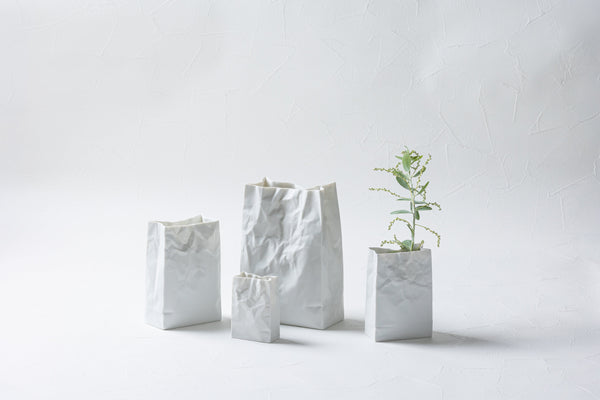
In 1975, Ceramic Japan released its iconic “Crinkle,” designed by Makoto Komatsu, who had worked as a designer for Sweden’s leading ceramics manufacturer, Gustavsberg. The vase resembles a paper bag.
In 1982, it was selected for permanent collection at the Museum of Modern Art (MoMA) in New York and continues to be loved worldwide.
The “Oiri Sumo” is highly popular with international tourists. It has been a bestseller since 1982.
This is the “Oiri Sumo” sumo wrestler figurine, designed by Masato Yamamoto, who worked as a product designer at Bodum Switzerland for 13 years and now lives in Switzerland.
In this way, the company has developed products by inviting top designers to collaborate and bringing their designs to life at the Seto pottery kilns.

For over 50 years, Ceramic Japan has challenged the status quo by bypassing wholesalers and building its own distribution network for its products.
“We continue to make the same products for as long as possible. My parents gave me a cup and saucer, and I wanted to create products that would allow someone to replace a saucer if they broke it. That is why we have continued this work,” says President MasayukiOhashi.
The company has also had customers visit the “Masukichi” store and say, “My mother had this!” When a daughter came to see the product, it reinforced the company’s belief that its products are truly loved for the long term.
Handcrafting time-consuming products with our own hands

Shintaro Minami, owner of “Masukichi,” and President Ohashi of Ceramic Japan.
President Masayuki Ohashi is the younger brother of the company’s founder, Toyokazu. He joined the company at age 30 after being invited by the two founders.
He originally worked in the construction industry and enjoyed working with others and tackling technical challenges. This led President Ohashi to shift the company’s focus from outsourcing production to pottery kilns to making products in-house.
“It troubled me deeply that we weren’t making the products ourselves. I felt that it was only natural for us to do so, so we decided to gradually bring production in-house.”

Ikuco Nakazawa, in her 23rd year with the company, carving a plaster model.
This is the prototyping room. Since its founding, Ceramic Japan has made its plaster models in-house. This is because the models are essential to the final product. Since ceramics shrink during firing, the models are made to account for this shrinkage. Because the company often takes on challenging shapes, the models are rarely perfect on the first try and must be adjusted and refined many times.

After mastering prototyping, the company began casting its own blanks, which were previously fired at pottery kilns. It gradually brought more production in-house, and in 2021, it built a studio on its premises. Today, approximately 60% of its products are manufactured there.

Initially, the company had only one small gas kiln, but it installed a new gas kiln in March 2026. Its size reflects the company’s commitment to production.

Many Ceramic Japan products require a great deal of effort to produce.
Developing new products also involves exploring how to bring them to life, which can be a long process of trial and error. Some products are so close to being ready that they are ultimately not released.
Yet Ceramic Japan continues to produce carefully crafted, time-consuming products. This is what makes the company remarkable and unique. In addition, all products are inspected in-house, ensuring consistent quality.For retailers,this high level of reliability is also a major advantage.
The company is now further expanding its in-house production, hiring one new employee each year. Today, 14 staff members work at the company, including one based in Tokyo. Many have degrees in fine arts, and the company has organized its operations so that production, inspection, and shipping are not strictly separated, allowing each employee to handle a wide range of tasks.
For over 50 years, Ceramic Japan has remained committed to redefining the role of production regions.
The company continues to look ahead and is worth watching for what comes next!
Written by Minami Miku
ABOUT THE MAKER
Ceramic Japan
Ceramic Japan is a ceramics manufacturer based in Seto, Aichi Prefecture. The company offers a range of designs and decorative objects beloved across generat...
MORE FROM THE MAKER
Ceramic Japan
-
Ceramic Japan | New Crinkle Super Bag S
Regular price From ¥3,520Regular priceUnit price per -
Ceramic Japan | New Crinkle Super Bag M
Regular price From ¥5,500Regular priceUnit price per -
Ceramic Japan | New Crinkle Super Bag L
Regular price From ¥7,700Regular priceUnit price per -
Ceramic Japan | Super Bag S
Regular price ¥4,180Regular priceUnit price per


