


Tsubaki Kiln | IZUMI Curry Plate
Tsubaki Kiln | IZUMI Curry Plate
Shipping: ¥700 flat rate / half-price shipping on orders of ¥11,000 or more
Couldn't load pickup availability
FAQ
Is it microwave and dishwasher safe?
Most pieces can be used in the microwave and dishwasher. Please avoid both for pieces with gold or silver decoration, earthenware with crackle glaze, and figurines. Hand washing is recommended for long use.
Will it look exactly like the photo?
Each piece is fired one by one at the kiln, so color, glaze flow and size vary slightly. Please enjoy it as the character of handmade ware.
When will it ship?
Orders ship within 3–5 business days via Yamato Transport. We will email you when it ships.
How much is shipping?
Shipping is ¥700. Orders of ¥11,000 or more get half-price shipping.
What if it arrives broken?
Please email us (masukichi@hitotsuchi.jp) within 7 days of arrival. We will replace or refund it at our cost.
Can I see it in person?
Many pieces are on display at our shop, Masukichi, in Seto, Aichi.


The “Ash Glaze Series,” inspired by “Kose-to” and made with natural ash
Modern vessels that emphasizegenerous negative space. Their simple, warm appearancecreated by natural ash glazes makes them a perfect match for any dish.
The white glaze is made primarily from the ash of the Japanese camphor tree, while the green glaze is made mainly from pine ash, a material that symbolizes Tsubaki Kiln.The black glaze is made from a variety of wood ashes with added iron, resulting in a glossy, translucent brown. These three ash glazes are used to create the vessels in the “Ash Glaze Series.”
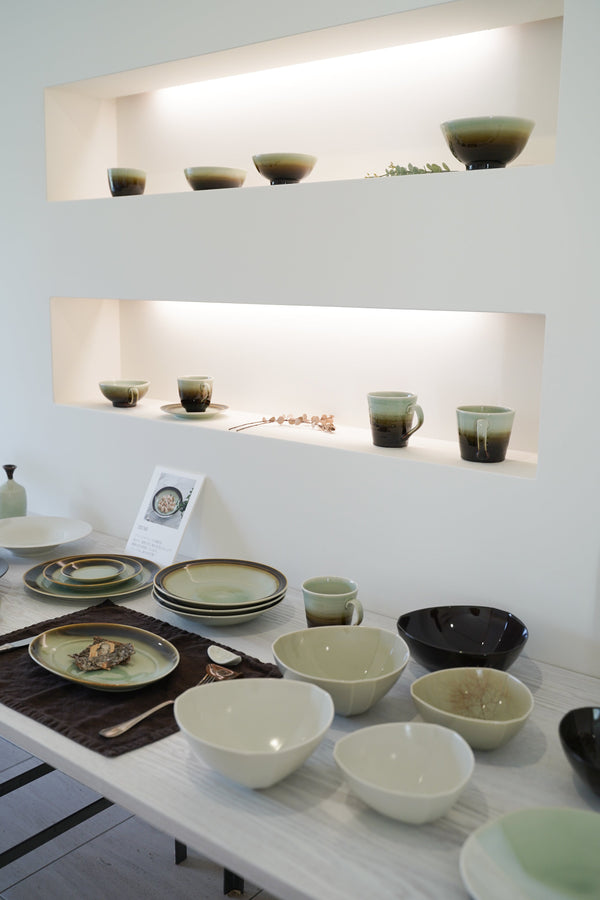
The IZUMI Series features green glaze with black glaze sprayed on to add color.

The soft, blurred outlines of the sprayed black glaze are beautiful.

The underside.

Viewed from above.
[About the Product]
Product Name: IZUMI Curry Plate
Material: Porcelain
Size: 23.0 cm × 23.0 cm × 4 cm
Microwave: Safe
Dishwasher: Safe
Oven: Not suitable
Manufacturer: Tsubaki Kiln
※As each piece is handcrafted at every stage of production, there may be slight variations in color and shape. We hope you enjoy these unique differences.
[Return and Exchange Policy]
For returns or exchanges due to customer convenience, the customer is responsible for round-trip shipping costs. Even if the item is unused, returns or exchanges due to differences in size, design, or color are considered to be for customer convenience. Please note that the product’s color may differ from the actual item depending on your browser, monitor performance, and settings. Please also note in advance that each piece has a unique finish.
[About Tsukurite]
Tsubaki Kiln: Modern vessels that make Japanese and Western dishes shine

Tsubaki Kiln islocated in the Mizuno area of Seto City, where many kilns are scattered.Founded in 1979, the first-generation owner, Haruji Hayashi, specialized in creating Seto blue-and-white porcelain.
When the second-generation owner, Eiji Hayashi, took over in 2012, he created the “Ash Glaze Series,” applying warm natural ash glazes to porcelain to develop a new signature product. It has become particularly popular with cooking enthusiasts.
In this introduction, we will explore the lesser-known history leading up to the founding of Tsubaki Kiln and discover what kind of pottery the kiln produces.
What is Tsubaki Kiln?

Tsubaki Kiln is located in a residential area of the Mizuno district, where a large workshop suddenly appears. Although it was founded in 1979, its lineage can be traced back over 200 years to a family that has been involved in pottery.
Going back to the 12th year of the Kansei era (1800), the kiln’s origins can be traced to “Kitashintani,” in the area that is now the city center where Masukichi is located. It was a blue-and-white porcelain kiln run by Yoshikuro Kato, who employed 18 artisans.
Seto blue-and-white porcelain is now designated as a traditional craft and is known as “Seto sometsuke.” The Seto Museum of Ceramic Art houses vases made by Yoshikuro for overseas customers.

From a catalog of paintings by Tomoshichi Kato, created around 200 years ago.
Tomoshichi Kato, who was adopted by Yoshikuro and took over the family business in the late Meiji era, became the next successor. He reportedly studied painting from the age of 10, and his drawings of birds and animals still exist today.
Later, around the 38th year of the Meiji era (1905), Yoshikuro is known to have employed four people in Kitashintani to manufacture clay jars. When the business passed to Kenkichi Kato, it moved closer to the city center to the Seido area, whereit appears they produced matcha bowls and other items.
Kenkichi’sson, andEiji Hayashi’s grandfather, Arata Katofounded “Asahi Seito” in Misato, Owari-Asahi City.The company manufactured blue-and-white porcelain for other companies under OEMand achieved explosive success with a series of underglaze designs called “Awatsubaki.”

It was then that Haruji Hayashi, a native of Toyota City who aspired to become a potter, came to work at the kiln and married Shinji’s eldest daughter. The second son eventually took over “Asahi Seito,” while Haruji became independent and founded “Tsubaki Kiln.”

The first-generation owner, Haruji, valued the blue-and-white porcelain techniques passed down through generationsand, influenced by blue-and-white porcelain from China’s Ming dynasty and other periods,developed his own mastery of “copperplate transfer,” a technique in which designs are engraved on copper plates, copied onto paper, and transferred to pottery.He perfectedSeto blue-and-white porcelain.
He established a system for mass production, supplying these vessels to wholesalers and trading companies in Kyoto and manufacturing for other companies under OEM.
A New Challenge by Second-Generation Owner Eiji Hayashi

Meanwhile, Eiji enrolled in the sculpture department at theNagoya College of Art and Design. He studied under Mr. Kawazato of Kyoto’s “Sadayama Kiln,”graduated from the Kyoto Prefectural Technical College of Ceramic Arts, where he studied Kyoto and Kiyomizu ware, and spent his twenties working as a ceramic artist in Higashiyama, Kyoto.
In 1999, his father asked him to help with the family business, and Eiji returned to Seto, where he had always hoped to one day take over.
However, having grown up surrounded by blue-and-white porcelain, Eiji said, “I love blue-and-white porcelain, but since my predecessors made it for so long, I want to try something different.” He decided to challenge himself by creating entirely new products.
“I wanted to create vessels that explored the roots of Seto, and the first thing that came to mind was “Kose-to” pottery. It was the first type of pottery in Japan made by applying natural ash as a glaze. I love its simple, rustic character. But I didn’t want it to be plain, so I wanted to add a distinctive touch.”
This led to the “Ash Glaze Series,” inspired by “Kose-to” and made with natural ash.

This “Ash Glaze Series” uses natural wood ash and features three different ash glazes.
The white glaze is made primarily from the ash of the Japanese camphor tree and was once used on fine porcelain. The green glaze is particularly symbolic of Tsubaki Kiln and is made mainly from pine ash.
Because the ash contains more iron than other types, it creates a soft celadon hue. The black glaze is made from a variety of wood ashes with added iron, resulting in a glossy, translucent brown.


Some vessels use these glazes in a single color, while others, like the “mike” series shown here, are finished by applying one of the three glazes, allowing it to dry, and repeating the process.

Another distinctive feature of Eiji’s vessels is their modern shapes, which complement both Japanese and Western dishes.
Having studied sculpture at university and worked as a ceramic artist, Eiji pays particular attention to form and creates the original models himself. He then has them cast into molds by a mold-making shop and produces the clay bodies in the workshop using slip casting or pressure casting.
In recent years, these original products have increasingly been showcased at international exhibitions, marking the beginning of the kiln’s expansion into overseas markets.
Vessels that make dishes shine

To see Tsubaki Kiln today, we recommend visiting the showroom adjacent to the workshop.
Almost all of the kiln’s original products are on display, so if you are interested, please contact them before visiting.
Eiji is also an excellent cook, and vessels made by someone who loves cooking are sure to make dishes look their best. They are often used in restaurants and are easy to use, including their ability to be stacked in a cupboard. The vessels feature generous negative space, so use your imagination and enjoy the art of plating!
Tsubaki Kiln
Address: 531 Mizukita-cho, Seto City, Aichi Prefecture
Hours: Weekdays 10:00 a.m.–2:00 p.m.
Closed: Please call to confirm before visiting.
Phone: 0561-48-1265
Parking: Available
Access: Approximately a 23-minute walk from Nakamizuno Station
Instagram: tsubakigama2018
ABOUT THE MAKER
Tsubaki Kiln
Founded in 1979, Tsubaki Kiln is a pottery studio in Mizuno, Seto City, Aichi Prefecture. Respecting the tradition of Old Seto ware, the studio produces its ...
MORE FROM THE MAKER
Tsubaki Kiln
-
Tsubaki Kiln | mike Mug
Regular price ¥4,180Regular priceUnit price per -
Tsubaki Kiln | mike Soup Cup
Regular price ¥4,180Regular priceUnit price per -
Tsubaki Kiln | mike Rice Bowl
Regular price ¥3,850Regular priceUnit price per -
Tsubaki Kiln | mike SORAMAME Small
Regular price ¥3,190Regular priceUnit price per


