


Fukai Glazed Coffee Cup | A Reward for Royalty
Fukai Glazed Coffee Cup | A Reward for Royalty
Shipping: ¥700 flat rate / half-price shipping on orders of ¥11,000 or more
Couldn't load pickup availability
FAQ
Is it microwave and dishwasher safe?
Most pieces can be used in the microwave and dishwasher. Please avoid both for pieces with gold or silver decoration, earthenware with crackle glaze, and figurines. Hand washing is recommended for long use.
Will it look exactly like the photo?
Each piece is fired one by one at the kiln, so color, glaze flow and size vary slightly. Please enjoy it as the character of handmade ware.
When will it ship?
Orders ship within 3–5 business days via Yamato Transport. We will email you when it ships.
How much is shipping?
Shipping is ¥700. Orders of ¥11,000 or more get half-price shipping.
What if it arrives broken?
Please email us (masukichi@hitotsuchi.jp) within 7 days of arrival. We will replace or refund it at our cost.
Can I see it in person?
Many pieces are on display at our shop, Masukichi, in Seto, Aichi.


Introducing “Lord’s Reward,” a piece of the “NAGOYA CASTLE” series of official Nagoya Castle souvenirs. This original product was created in collaboration with Nagoya Castle, which reached out to us.
What is “Lord’s Reward”?
Tokugawa Yoshinao, the first lord of Nagoya Castle, encouraged the development of pottery in the prosperous region, inviting potters from the pottery-producing area of Seto to the castle grounds. This led to the creation of “O-fuke Ware,” crafted to suit the lord’s tastes and serve as gifts.
The area around Nagoya Castle was once known as “Shita-Ofukeniwa” and served as the lord’s private garden. Potters from the pottery-producing area of Seto were invited to this corner of the garden, where they created works and gifts tailored to the lord’s tastes. This series was born from that history.

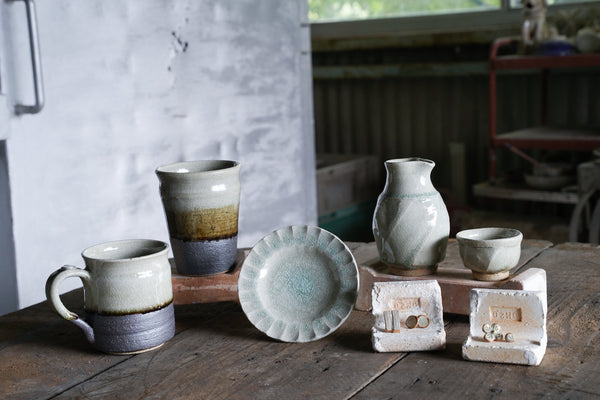
The “Lord’s Reward” series.
From left to right: an O-fuke-glazed coffee cup, an O-fuke-glazed teacup, an O-fuke-glazed small plate, an O-fuke-glazed sake bottle, an O-fuke-glazed sake cup, and an O-fuke-glazed ear scoop.

O-fuke-glazed coffee cup.
It holds over 300 ml, making it perfect for those who want to enjoy plenty of coffee.
It is considerably larger than sizes typically made for Japanese users, making it a size that will also be appreciated by people from overseas.
The handle is generously shaped, allowing two fingers to fit comfortably inside.The top features a smooth, glassy O-fuke glaze. Below it is a rough-textured “bengara” glaze, which is said to be Japan’s oldest pigment.

The back features the NAGOYA CASTLE golden shachihoko mark.
O-fuke glaze is the signature glaze of O-fuke Ware.

O-fuke Ware includes a wide variety of pottery, but pieces made with a glaze combining feldspar and wood ash are known as “O-fuke glaze” and are representative of O-fuke Ware.It is characterized by a transparent blue-green color and a clear, celadon-likehue.
The “Lord’s Reward” series was created not only by us, but also with the design direction of“studio point,” a design firm that creates numerous pottery products.
It was further realized by commissioning production from “Kitaki-gama Kasen,” a long-established kiln that has been operating in the Seto-Akutsu area for approximately 370 years.
Please note that there may be individual differences in how the glaze appears on each product. We hope you will enjoy these O-fuke Ware pieces, once cherished by lords, as a “reward.”
[About the Product]
O-fuke-glazed coffee cup | Lord’s Reward
Material: Ceramic
Size: Diameter 8.5 cm × Height 9 cm
Capacity: Approximately 300 ml
Texture: Glossy with a noticeable glassy glaze.
Microwave: Safe Dishwasher: Safe
Oven: Not suitable
Manufacturer: Kitaki-gama Kasen
※Because each piece is thrown on the potter’s wheel one by one, the size and capacity may vary slightly. Please use these measurements as a general guide.
[Before First Use]
Before using, boil the piece in rice-washing water for about 3 minutes. During the initial period of use, the piece will absorb moisture readily. Please avoid leaving drinks in it for extended periods or placing it immediately into a cupboard, as residual moisture may cause mold.
[Notes on Returns and Exchanges]
For this product, returns and exchanges due to customer convenience will require the customer to cover the round-trip shipping costs. Even if unused, returns and exchanges due to differences in size, design, or color from what was expected will be considered a return for customer convenience. Please note that the color, texture, and other characteristics of the product may differ slightly from the actual item depending on your browser, monitor performance, and settings.
[About Tsukurite]
A kiln with ties to the Owari Tokugawa family. A long-established kiln in Seto-Akutsu“Kitaki-gama Kasen”

Hiroshige Kato, the twelfth head of “Kitaki-gama Kasen.”
“Kitaki-gama Kasen” is a long-established kiln that has been operating in the Seto-Akutsu area for approximately 370 years.
TheAkutsu area, where the workshop is located,is a special place within Seto, a major pottery-producing city. It is the area where “Akutsu Ware,” a traditional craft ceramic,is made, and it is said to have pioneered the first fully developed glazing techniques in the history of Japanese pottery.

Akutsu was once home to “Tōzaburō-gama,” which served as a kiln for the Owari Tokugawa family and actually fired pottery for Nagoya Castle,and “Kitaki-gama Kasen” is a branch of that kiln.
While carrying on this tradition, the kiln also sells pottery at prices accessible to many people.He also kindly explained a great deal about O-fuke Ware.We entrust him with the role of a modern-day kiln for the Reiwa era, one that feels approachable and suited to the times.

Unfired sake cup.

Applying O-fuke glaze made with wood ash.

The kiln.
The techniques that “Kitaki-gama Kasen” has cultivated and passed down. Please enjoy using pottery filled with these techniques.
ABOUT THE MAKER
Kitagama Kasen
Established in 1656, Kitaki Kasen is a pottery studio in Akazu, Seto City, Aichi Prefecture. Its “Danna-sama no Gohoubi” series of Fukaig釉 vessels is also an...
MORE FROM THE MAKER
Kitagama Kasen
-
Fukai Glazed Small Dish | A Reward for the Lord
Regular price ¥1,760Regular priceUnit price per -
Fukai Glazed Tokkuri | A Reward for the Lord
Regular price ¥3,850Regular priceUnit price per -
Mifukai Glazed Sake Cup | A Reward for the Lord
Regular price ¥1,980Regular priceUnit price per


