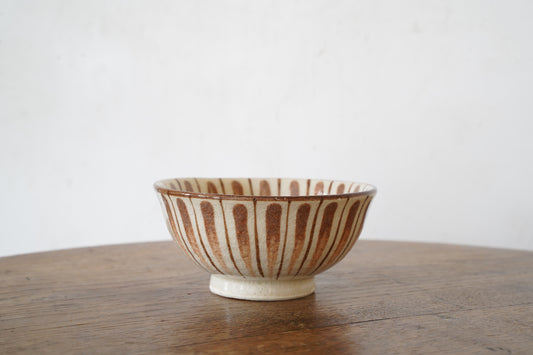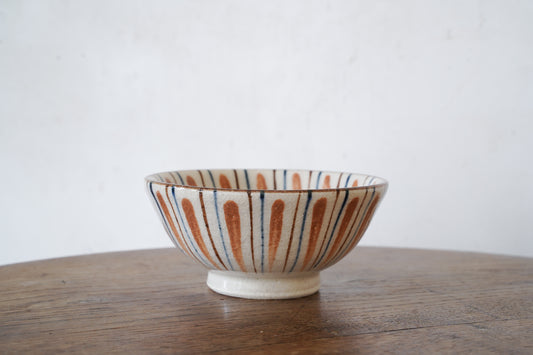


Setohonyogyo | Mugiwara Rice Bowl (Large)
Setohonyogyo | Mugiwara Rice Bowl (Large)
Shipping: ¥700 flat rate / half-price shipping on orders of ¥11,000 or more
Couldn't load pickup availability
FAQ
Is it microwave and dishwasher safe?
Most pieces can be used in the microwave and dishwasher. Please avoid both for pieces with gold or silver decoration, earthenware with crackle glaze, and figurines. Hand washing is recommended for long use.
Will it look exactly like the photo?
Each piece is fired one by one at the kiln, so color, glaze flow and size vary slightly. Please enjoy it as the character of handmade ware.
When will it ship?
Orders ship within 3–5 business days via Yamato Transport. We will email you when it ships.
How much is shipping?
Shipping is ¥700. Orders of ¥11,000 or more get half-price shipping.
What if it arrives broken?
Please email us (masukichi@hitotsuchi.jp) within 7 days of arrival. We will replace or refund it at our cost.
Can I see it in person?
Many pieces are on display at our shop, Masukichi, in Seto, Aichi.


This rice bowl features the traditional straw-hand motif and is made by Setohonyogyo, a pottery studio in Seto City that has been in operation since the late Edo period.
What is the straw-hand motif?
It is a traditional design reminiscent of ears of wheat. The glaze is a weathered mineral-based "red raku" that feels slightly bumpy to the touch.
This rustic pattern is well known for being praised by Yanagi Muneyoshi, the thinker who started the Mingei movement, and for being loved by the essayist Shirozu Masako.

Front view.

It is carefully painted not only on the outside but also on the inside.
Every piece from Setohonyogyo reveals even greater beauty when filled with food.
Made of stoneware, it is thick and extremely durable. Its practicality is one of its greatest appeals.

A size that fits perfectly in your hand.
A vessel that develops over time

[About the product]
Name: Straw-hand rice bowl
Material: Stoneware
Size: Approx. 13 cm in diameter × 6 cm high
Texture: Glossy, with a visible glassy glaze.
Microwave: Safe to use Dishwasher: Not recommended (but usable)
Oven: Not suitable
Manufacturer: Setohonyogyo
※Because each piece is thrown on the potter’s wheel one by one, its size and capacity may vary slightly. Please use these measurements as a general guide.
[Care for first use]
Before first use, boil the bowl in rice-washing water for about 3 minutes. During the initial period of use, the vessel absorbs moisture readily. Avoid leaving drinks in it for extended periods or placing it immediately into a cupboard, as residual moisture may cause mold. If mold appears, it will only be on the surface, so simply wash it off. It is harmless and will disappear with continued use.
This work is done entirely with natural materials. No harmful chemicals such as lead or cadmium are used, and the glaze and clay are prepared using traditional methods. We hope you will understand the inherent nature of working with clay.
[Notes on returns and exchanges]
For this product, returns and exchanges due to personal reasons will be subject to the customer bearing the round-trip shipping costs. Even if the item is unused, returns and exchanges due to differences in size, design, or color from what you expected will be considered a return for personal reasons. Please note that the product’s color and texture may differ slightly from the actual item depending on your browser, monitor performance, and settings.
[Introducing the makers of Seto Tsukurite]
Handcrafted work rooted in daily life. Setohonyogyo, a pottery studio with a history dating back to the Edo period

Setohonyogyo is located in the Horan area of Seto City, about 1.5 km from Owari-Seto Station.Since the mid-Edo period, it has produced everyday items such as plates with the horse-eye motif, stone plates, and, from the Meiji era onward, Japan’s first ceramic tiles, known as “Honyogyo tiles.”
Here, they continue work closely related to the craftsmanship of Seto that has endured since the Edo period or even earlier.
“Honyogyo” refers to stoneware. Because Seto has long been known for producing stoneware, the newly developed porcelain is called “shinsei.”

Because Horan was a town nestled between two mountains, it is said that countless climbing kilns once lined the mountain slopes. The “kamajiki” walls built to hold the tools used in those climbing kilns were created during that time. They have been carefully preserved by the townspeople over many years.
The approximately 400-meter stretch of this wall, once the main street where artisans came and went, is known as the “Kamajiki Alley” and retains the distinctive atmosphere of a pottery-producing area.

In 2022,the “Seto Museum of Craft and Living [Seto Mingei Museum]” also opened. The museum houses a climbing kiln designated as a cultural property of Seto City, and its remains still evoke the image of what is said to have once been a 13-chamber kiln.
The museum was established to introduce the local craft culture passed down by previous generations. It also aims to show how vessels connect people and convey the “lives” of the people behind them.
Handcrafted production

Sayumi Kawai, who works as an artisan.
At Setohonyogyo, which continues to pass on the traditional pottery world of Seto to the present day, approximately 2,000 pieces are handcrafted each month. The pieces are primarily thrown on the potter’s wheel.

The designs are painted by professional painters, depending on the motif.
By adopting a division of labor, each person repeats the same process. This allows them to become more skilled and improves both quality and production speed, which is why the studio uses this system.
Making clay from raw earth
The work on the potter’s wheel and the painting you see here are likely what most people imagine when they think of handcrafting.
But have you ever thought about the raw materials that come before that?
At Setohonyogyo, they make their own clay from raw earth. Seto produces a high-quality clay known as “kaerame” clay, which is said to be among the finest in the world.
However, raw earth cannot be used as clay in its natural state.When asked about making the clay, Yusuke explained the process in great detail.
“We buy raw earth from the mountains of Seto—known locally as white clay and characterized by its kaerame texture—crush it into pieces, and pass it through a sieve. Then we mix it with water and let it rest. Kaerame clay is graded, but we deliberately choose a coarser, more rustic variety so that it does not become too refined.”

“If you try to extract the clay content from raw earth, impurities are gradually removed during the process. This causes the clay to become more like porcelain clay. We simply take dried clay that has been dried once and mix it with water, returning it to the state it was in when it was in the mountains. This method is not common. It is a bit special.”
Other additions include ki-bushi clay and chamotte.

This is ki-bushi clay. It is made by adding water to dried ki-bushi clay to turn it into clay. It is added to make throwing on the potter’s wheel easier.
It has a strong ability to hold its shape and is favored by sculptors making figures and other models, but because it shrinks so much, only a small amount is added.

Chamotte is crushed fired clay. It feels rougher than white clay. Ki-bushi clay shrinks so much that chamotte is added to control this shrinkage. Because it has already been fired once, it is said that it does not shrink as much.

This is the mixture. The amount of water added is determined by the clay’s consistency.This is the clay after it has been mixed and left to rest for about one month.

The clay after three months of maturation. It becomes more uniform throughout.

The clay is prepared about once every two months. When it is ready to use, it is put through a clay mixer to knead it.
Glazes are also made from natural materials

Glaze samples.
All the glazes are handmade. “Ash glaze” is made by burning the Japanese red pine that grows abundantly in the mountains of Seto and turning the ash into glaze. Copper is added to this base to create a green glaze. Iron is added to make an iron glaze. Rice straw ash is added to create a white glaze.

Gentle colors born from nature.
The abundance of the land that has provided the materials for pottery in Seto is evident in the way it has shaped the town’s way of life.
What we find so remarkable about Setohonyogyo
Finally, what we find truly remarkable is that whenever we ask Yusuke Mizuno, the eighth-generation owner, a question about any one of the pieces he makes, he always answers immediately.
For example, he can explain how the coffee cup, which was not originally a Japanese vessel, came to Setohonyogyo. There is a history behind it, a clear reason, and Yusuke himself is always acutely aware of it. We are always moved by this. You can truly feel the answers for yourself when you use the pieces. We hope you will experience them for yourself.
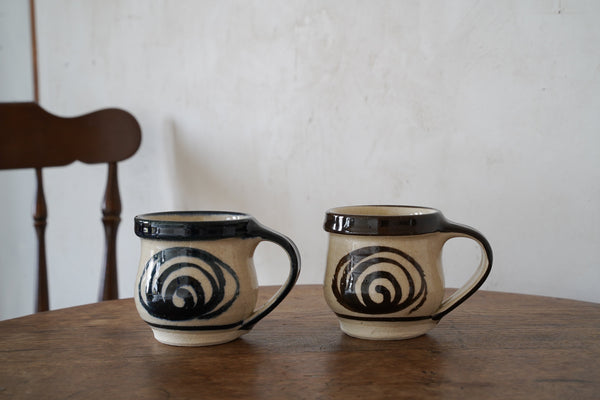
ABOUT THE MAKER
Seto Hongyo Gama
Setohonyogyo is a pottery studio in Seto City, Aichi Prefecture, with a history dating back to the late Edo period. The studio produces traditional Seto pott...
MORE FROM THE MAKER
Seto Hongyo Gama
-
Setohonyo | Mugiwara Rice Bowl (Small)
Regular price ¥3,300Regular priceUnit price per -
Setohonyogyo | Mugiwara-de / Tokusa Rice Bowl (Large)
Regular price ¥3,850Regular priceUnit price per -
Setohonyo | Sansai Small Dish, 4 sun
Regular price ¥2,640Regular priceUnit price per -
Setohonyogyo | Medium Sansai Teacup
Regular price ¥4,950Regular priceUnit price per